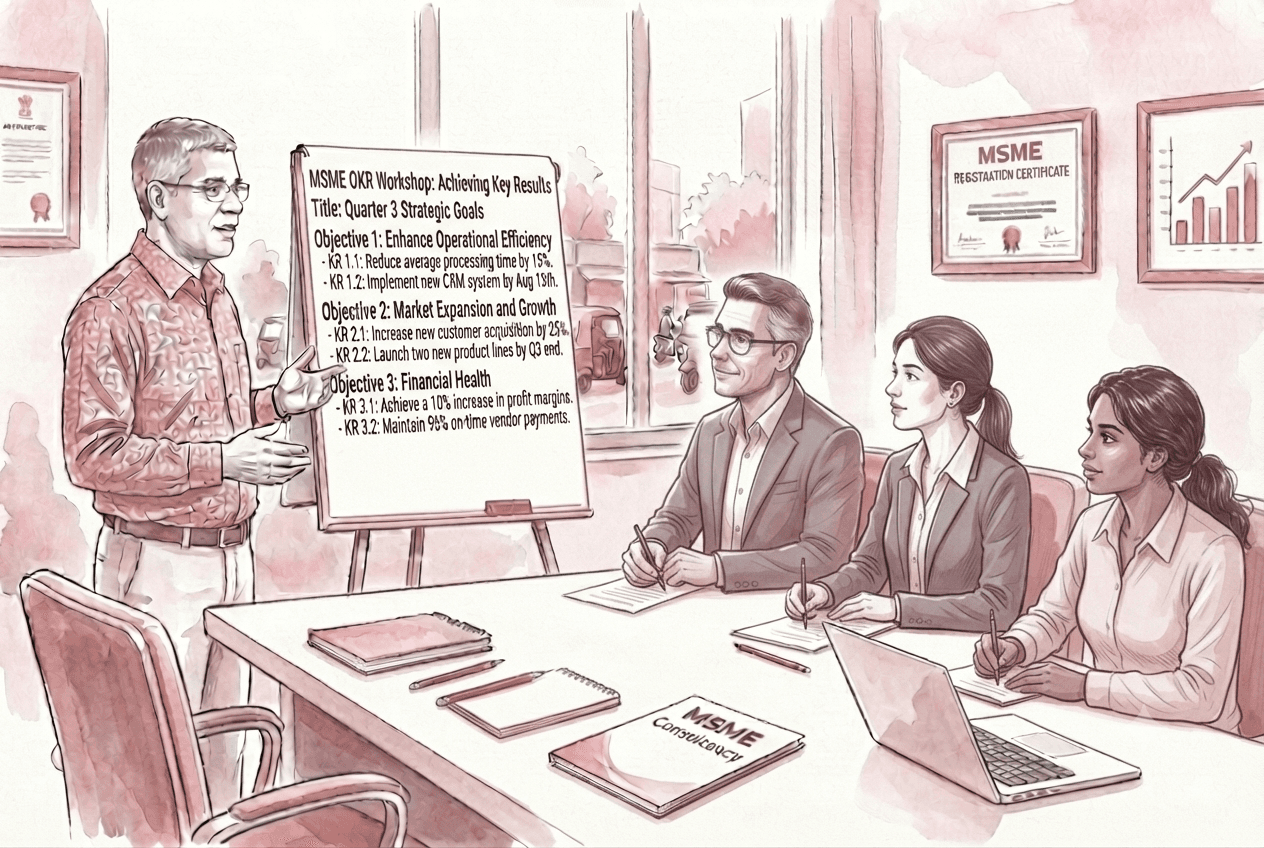
Simpleworks designs OKR frameworks for Indian MSMEs and startups — simple enough for a 20-person team to use without a consultant in the room, specific enough to actually move the business.
What is an OKR — and why does your business need one?
OKR stands for Objectives and Key Results. It is a goal-setting framework used by organisations to define what they want to achieve and how they will know if they’ve got there. Here is what each part means in practice.
The O
Objective
An Objective is a clear, qualitative statement of what you want to achieve. It answers the question: where are we going? It should be ambitious enough to require real effort, specific enough to give the team a direction, and short enough to remember without looking it up.
Example
“Become the preferred supplier for industrial components in the Pune region by Q3.”
The KR
Key Results
Key Results are the measurable outcomes that tell you whether the Objective is being achieved. They answer the question: how will we know we got there? Each Objective has two to four Key Results — specific, time-bound, and owned by a named individual.
Example Key Results
KR1: Win 8 new accounts in Pune by September 30. KR2: Achieve ₹40 lakh in new revenue from the region by Q3 end. KR3: Maintain a customer satisfaction score above 4.2 across all new accounts.
OKR vs. KPI
Most MSMEs track KPIs. That is not the same as having OKRs.
KPIs tell you how your business is performing. OKRs tell you where it is going. Both matter — but they do different jobs.
KPI — Key Performance Indicator
OKR — Objective & Key Result
What it does: Measures ongoing health of the business
What it does: Defines where the business is going and how it will get there
Example: Win 8 new accounts in Pune by Q3 · Launch two new product lines by September
Cadence: Tracked monthly or quarterly, relatively stable
Cadence: Set quarterly, reviewed weekly, reset each cycle
Tells you: Whether the business is healthy right now
Tells you: Whether the business is moving in the right direction
What We Do
What OKR consulting looks like in practice
OKR consulting at Simpleworks is not a training workshop. It is the work of designing and launching a goal system that fits your specific business — and staying until the team can run it without us.
01 — OKR Design
Building OKRs that actually fit your business
Most OKR failures happen at the design stage — goals that are too vague, too many, or too disconnected from the strategy. Simpleworks designs the full OKR framework: company Objectives, function-level Key Results, and the ownership map that tells every team member exactly what they are accountable for this quarter.
02 — Cascade & Alignment
Connecting company goals to team action
The most common OKR mistake is setting company-level goals that never reach the team. Simpleworks builds the cascade — translating each company Objective into function-level OKRs for sales, operations, finance, and wherever else the work happens. Every team member knows how their work connects to the company's direction.
03 — Review Rhythm
Designing the cadence that keeps OKRs alive
OKRs don't maintain themselves. Simpleworks designs the review rhythm: weekly check-ins that take 20 minutes, monthly reviews with clear decisions, and quarterly resets that adjust goals to what the business has learned. Without this rhythm, even the best OKRs become irrelevant within six weeks.
04 — Live Cycle Support
Running the first two cycles alongside your team
We don't hand over a framework and leave. Simpleworks runs the first two OKR cycles with your team — coaching leaders through the weekly reviews, adjusting the system where it isn't working, and building the muscle memory for goal-setting and accountability that the organisation will rely on long after we've stepped back.
Who We Work With
The situations that bring founders to OKR consulting
OKR consulting is rarely the first thing a founder asks for. They describe a different problem — and OKRs turn out to be the missing piece.
01
The team is busy but the business isn't moving
Everyone is working hard. The founder is working hardest. But at the end of the quarter, the numbers haven't moved and nobody can explain exactly why. Activity is high. Progress is unclear. The problem is the absence of goals specific enough to create direction and accountability at every level of the team.
02
Annual targets exist but nobody owns the path to them
The business has a revenue target for the year. Everyone knows the number. No one can tell you which specific actions — owned by which specific people — will get the business there by December. A target without a cascade of OKRs beneath it is a wish, not a plan.
03
Previous OKR attempts haven't worked
Many founders have tried OKRs — often after reading a book or attending a workshop — and found that within two quarters, the system was quietly abandoned. This is almost never a failure of intent. It is a failure of design: too many objectives, no review rhythm, and goals that weren't connected to the real work of the business.
04
The team has grown past what informal management can handle
A 6-person team can be managed through proximity and conversation. A 25-person team cannot. When the business grows past the point where the founder can personally track what everyone is working on, a formal goal system stops being optional. OKRs are the right tool for this transition — if they're designed for the actual capacity of the team.
If any of these describe your business, a 30-minute conversation is the right starting point.
Every OKR engagement at Simpleworks follows the same six-step process — adapted to the size and context of your business, not copied from an enterprise template.
01
Diagnose
Understand the strategy before designing the goals
OKRs are only as good as the strategy they express. Before designing any framework, Simpleworks works with the founder and leadership team to clarify the three to five things that matter most for the business this year. Not twenty things. Three to five. Everything else waits — or doesn't make it into the OKR system at all.
02
Design
Write the Objectives and Key Results at every level
Company OKRs first, then function-level OKRs that cascade from them. Each Objective has two to four Key Results — specific, measurable, and owned by a named individual. Simpleworks writes the first draft and refines it with the team through structured workshops, not through a template dropped in a shared folder.
03
Assign
Name the owner of every Key Result
Shared accountability is no accountability. Every Key Result is assigned to one person — the individual who will be asked about it at every review. Not a department. Not a team. One person, whose name is on the result. This single change — from collective to individual ownership — is the biggest lever in making OKRs actually work.
04
Launch
Introduce the system to the full team — not just leadership
OKRs fail when they are designed in the boardroom and handed down to the team as a completed document. Simpleworks runs the launch session with the full team — every function head, every Key Result owner — so that each person understands their OKRs, has had a chance to challenge them, and starts the cycle with genuine commitment rather than compliance.
05
Review
Run the first cycle alongside the team
Simpleworks attends and facilitates the first four to six weekly check-ins and the mid-cycle review. This is where most OKR systems fall apart — the first time a Key Result is off track and nobody knows whether to adjust the target, accelerate the effort, or escalate. We build the judgment in the team to make those calls confidently.
06
Reset
Run the second cycle — then hand over to the team
The end-of-cycle reset — scoring the OKRs, learning from what worked and didn't, and setting the next quarter's goals — is the hardest part of running OKRs and the skill most teams lack. Simpleworks runs the first reset with the team, then progressively reduces involvement in the second cycle so the organisation builds the capability to run it independently.
Why Simpleworks
Why OKRs built for MSMEs work differently
Most OKR frameworks are designed for technology companies with dedicated HR business partners, OKR software, and quarterly planning cycles that involve fifty people. Simpleworks builds OKR systems for businesses that have none of this.
The OKR playbook that companies like Google and Intel made famous assumes an organisation where the strategy team, the HR function, and the business units all have time dedicated to the goal-setting process. In a 30-person MSME where the sales head is also doing account management and the operations lead is also handling vendor relationships, that assumption breaks immediately.
Simpleworks designs OKR frameworks that fit within the actual capacity of lean teams. Fewer Objectives — never more than three to five per quarter. Shorter review cycles — weekly check-ins that take 20 minutes, not two hours. No dependency on expensive software. A system that the team can run without a dedicated OKR champion or an HR partner to maintain it.
“An OKR system that requires a full-time administrator to maintain is a bad OKR system. The right framework takes the same amount of time each week as a good team meeting — and replaces three bad ones.”
— Prem Menon, Founder, Simpleworks Consulting
Every OKR engagement at Simpleworks ends with the team able to run the system independently. If the team still needs Simpleworks to manage their OKRs after six months, we haven’t done our job.
Built for lean teams — not enterprise functions
Three to five Objectives per quarter. Two to four Key Results per Objective. Weekly check-ins under 30 minutes. A system designed for the team you have, not the team a Silicon Valley OKR playbook assumes.
No software dependency
We start with a spreadsheet. If a software tool would genuinely help your team, we'll recommend one. But the system works without it — which matters when the team is stretched and adoption is fragile.
Two live cycles before handover
We don't hand over a framework and disappear. Simpleworks runs the first two OKR cycles alongside your team — including weekly reviews, mid-cycle adjustments, and the end-of-cycle reset — before stepping back.
Prem Menon leads every engagement personally
No junior consultants. No workshops delivered by an associate. Prem works directly with your leadership team on the OKR design, the launch, and the first two review cycles.
From the Blog
Going deeper — articles on OKRs for Indian businesses
These articles explore the OKR questions most MSME founders are working through — and how Simpleworks thinks about them.
A Simple OKR Template for MSME Founders — With Real Examples
Common Questions
Frequently asked questions
Everything you need to know before we speak.
What is OKR consulting — and is it different from a workshop?
An OKR workshop teaches you how OKRs work — typically in a half-day or one-day session. OKR consulting is the work of actually building and launching the OKR system in your business — designing the Objectives and Key Results, assigning ownership, establishing the review rhythm, and running the first live cycles alongside your team. A workshop produces understanding. Consulting produces a working system.
Do we need OKR software?
No. Simpleworks starts every OKR engagement with a spreadsheet — a shared Google Sheet that tracks Objectives, Key Results, owners, and progress in one place. If a dedicated OKR tool would genuinely help the team, we'll recommend and help implement one. But for most MSMEs between ₹1 crore and ₹50 crore, the overhead of a software platform is higher than its benefit in the first year.
We already set annual targets. Is that the same as OKRs?
Not quite. Annual targets tell you where you want to end up. OKRs tell you — quarter by quarter — what specific progress you are making towards those targets, who is responsible for each piece of that progress, and whether the plan is working or needs to change. Annual targets without quarterly OKRs are goals without a game plan. Most MSME founders who engage Simpleworks for OKR consulting have targets. What they are missing is the structure beneath them.
How many OKRs should a small business have?
At the company level: three to five Objectives per quarter, each with two to four Key Results. At the function level: two to three Objectives per team per quarter. The instinct of most businesses is to set too many — to capture every priority on a long list. This is the most common OKR design mistake. Fewer OKRs, owned more deeply, deliver more than a comprehensive list that nobody tracks seriously.
How long does an OKR consulting engagement typically last?
A full OKR engagement — covering design, launch, and two live cycles — typically runs four to six months. The first four to six weeks cover the strategy diagnosis and OKR design. The following two to three months cover the first live cycle with Simpleworks' active involvement. The final month covers the second cycle with progressively reduced support as the team builds the capability to run the system independently.
What does the first step look like?
A free 30-minute conversation with Prem Menon. No pitch, no proposal. You describe where your business is and what is making goal-setting and accountability difficult — Prem asks a few direct questions and tells you honestly whether an OKR engagement would help, what it would involve, and what it would cost in approximate terms. If it is not the right fit, he will say so and point you in the right direction.
The first conversation is free.
Tell us where goal-setting and accountability are breaking down in your business. We’ll tell you honestly whether OKRs are the right tool — and what building them would look like.