Why Strategy Execution Fails in Indian MSMEs — and What to Do About It
Most Indian MSMEs don't plateau because their strategy is wrong — they plateau because nobody is executing the strategy they already have. The gap isn't strategic; it's structural, and it closes with three unglamorous fixes: named ownership, reviews with teeth, and a founder willing to step back.
Every year, thousands of Indian MSME founders sit through planning sessions, write annual targets, and leave the room with a shared sense of direction. Six months later, the targets are unchanged. The conversations are identical. And the founder is doing more work than ever, with less to show for it.
This is the strategy execution gap — and it is the single most common reason Indian MSMEs plateau between ₹2 crore and ₹20 crore. Not bad strategy. Not bad market timing. Not even bad people. The plan was fine. The execution failed. And in most cases, nobody in the organisation can tell you exactly where it broke down or why.
As a strategy execution consulting practitioner working with founders across manufacturing, SaaS, and distribution, I’ve seen this pattern across sectors and revenue bands. This post is about that gap — why it opens, what keeps it wide, and what it actually takes to close it.
The Strategy Execution Gap Is Not a Strategy Problem
The conventional response to a business that isn’t hitting its targets is to do more planning. Refine the strategy. Get clearer on priorities. Run another offsite. Bring in a consultant to sharpen the vision.
This is usually the wrong diagnosis.
In a study of 400 global companies by the Harvard Business Review, 49% of senior executives said their organisations had trouble bridging the gap between strategy and day-to-day execution — and that was in companies with dedicated strategy functions, professional managers, and quarterly board reviews. In an Indian MSME where the founder is simultaneously the head of sales, operations, HR, and finance, the gap is wider and the feedback loops are slower.
The problem is not the plan. It is the absence of a system to turn the plan into action.
Think of it this way: a railway timetable is not a railway. You can print the most efficient timetable in the world, but without tracks, signals, engines, and drivers who know their route, no train leaves on time. Indian MSMEs routinely produce timetables — annual plans, revenue targets, product roadmaps — and then wonder why the trains don’t run.
The tracks are what’s missing. And they’re built from four things most MSMEs don’t have: clear goal ownership, a review rhythm, decision authority at the right level, and consequences that are real.
Why Ownership Is the First Thing to Break Down
Ask most MSME founders who owns the revenue target for Q3. They will name themselves.
Ask their sales lead the same question. You will get: “We all do.”
Shared accountability is no accountability. When a goal belongs to everyone, it belongs to no one — and when it isn’t met, there is no one to hold the conversation with.
This is the first and most fundamental way strategy execution fails in Indian MSMEs: goals are set at the company level and never cascaded to the person who should own each one.
OKRs — Objectives and Key Results — solve exactly this problem. Not because the framework is clever, but because it forces a conversation that most organisations avoid: who, specifically, is accountable for this number? Not who contributes to it. Who owns it?
The experience at Simpleworks Consulting across manufacturing, telecom, consumer goods, and SaaS businesses is consistent: the moment you assign a key result to a named individual — not a department, not a function, a person — accountability sharpens. Not because the person suddenly cares more. Because they now know that their name is on it, and that someone will ask about it next month.
This sounds obvious. It is not widely practised. Most Indian MSMEs run their businesses on targets that belong to everyone and therefore get defended by no one.
Why Review Rhythms Decay — and Why It Matters More Than the Plan
The second way execution breaks down is the collapse of the review.
Here is what typically happens. In January, a team agrees on the year’s priorities. In February, the first monthly review is rigorous: numbers are checked, gaps are discussed, actions are assigned. By April, the review is shorter. By June, it has been rescheduled twice. By September, it has quietly become an informal conversation in the founder’s office. By December, everyone is too busy closing the year to look at whether the plan was executed.
This decay is not laziness. It is the predictable result of reviews that have no structure and no teeth.
A review that surfaces a problem but assigns no owner and sets no next action is not a review — it is a status update. And status updates, repeated monthly, teach teams that the review exists to report numbers, not to change them. They optimise for the report. They stop asking whether the underlying reality needs to change.
The fix is not more frequent reviews. It is reviews that produce three outputs every time: what is off track, who owns the fix, and what specifically will they do before the next session. Without these three outputs, the review is theatre.
This is what the Simpleworks 5D Method — Diagnose, Define, Design, Deploy, Drive — is built around. Not the goal-setting. The ongoing rhythm that keeps a team executing after the consultant has left the room.
The Founder Bottleneck: When Involvement Becomes the Constraint
There is a third failure mode specific to Indian MSMEs that is rarely discussed honestly: the founder who cannot step back from decisions.
In the early stages of any business, the founder’s direct involvement is not a bug — it is how the business survives. The founder’s judgment, speed, and pattern recognition is often the only reliable asset the company has.
But at a certain point — usually between ₹3 crore and ₹15 crore in revenue — this becomes the binding constraint. The business can only move as fast as the founder can personally review and approve. Sales opportunities are lost because a proposal takes two weeks to get signed off. Operational problems persist because only the founder can negotiate with the supplier. The strategy exists in the founder’s head, which means no one else can execute it independently.
Consider how Kiran Mazumdar-Shaw has described the shift at Biocon in its early scaling years: the deliberate, explicit decision to build management infrastructure so the company could operate without her in every conversation. Biocon is not an MSME, but the structural problem is identical — and the willingness to build systems ahead of the need is exactly what separates businesses that scale from businesses that plateau.
Fixing the bottleneck is not a people problem. It requires explicit role definitions, decision rights mapped to each function, and a period of deliberate discomfort where the founder holds back even when they know they could solve it faster.
None of this appears in an annual plan. All of it determines whether the annual plan gets executed.
The Counter-Argument: Don’t Some MSMEs Just Have the Wrong Strategy?
A reasonable objection: isn’t it possible that the strategy is the actual problem, and that better execution of a wrong strategy just gets you to the wrong place faster?
Yes. Absolutely. There are Indian MSMEs where the strategy is genuinely broken — serving the wrong market, with the wrong product, at the wrong price. In those cases, better execution would accelerate the wrong outcome.
But this objection, while valid, is far less common than it appears. Across manufacturing, distribution, telecom, and SaaS businesses in India, the number of companies with a fundamentally broken strategy is significantly smaller than the number of companies with a reasonable strategy that nobody is executing.
The tell is simple: if you ask the leadership team to describe the strategy and get five different answers, the problem is not the strategy — it is that it was never communicated, owned, or connected to day-to-day work. The strategic intent exists. The execution infrastructure does not.
That said, execution consulting is not the right answer for a business that needs to fundamentally rethink its market or offering. Diagnosis matters first. The first job — as Prem Menon describes in his work with MSME founders across India — is always to determine which kind of problem you actually have before prescribing the solution.
What Closing the Gap Actually Requires
The strategy execution gap in Indian MSMEs does not close because someone writes a better plan. It closes when three things are true simultaneously.
Goals are owned. Not shared. Not “everyone’s responsibility.” Each objective has one named individual who will be asked to account for it at the next review.
Reviews have teeth. Every review ends with a decision, an owner, and a deadline. The meeting that produces no action is cancelled next time.
The founder steps back. Not out. Back. Enough to let the team develop the judgment and accountability the business needs to run without constant intervention.
These three things are not complicated. They are, however, uncomfortable — particularly the third. A founder who has spent fifteen years being the fastest problem-solver in every room does not easily learn to watch someone make a slower, slightly worse decision and say nothing.
But that discomfort is the price of a business that scales. A business that cannot operate without its founder present is not a company — it is a founder with staff.
About Prem Menon
Prem Menon is the founder of Simpleworks Consulting, working with MSME founders and growth-stage businesses across India to turn strategy into execution. With experience spanning manufacturing, SaaS, retail, and professional services, Prem brings a practitioner’s eye to the problems most consultants only theorise about.
Is the gap between your strategy and your results costing you another year?
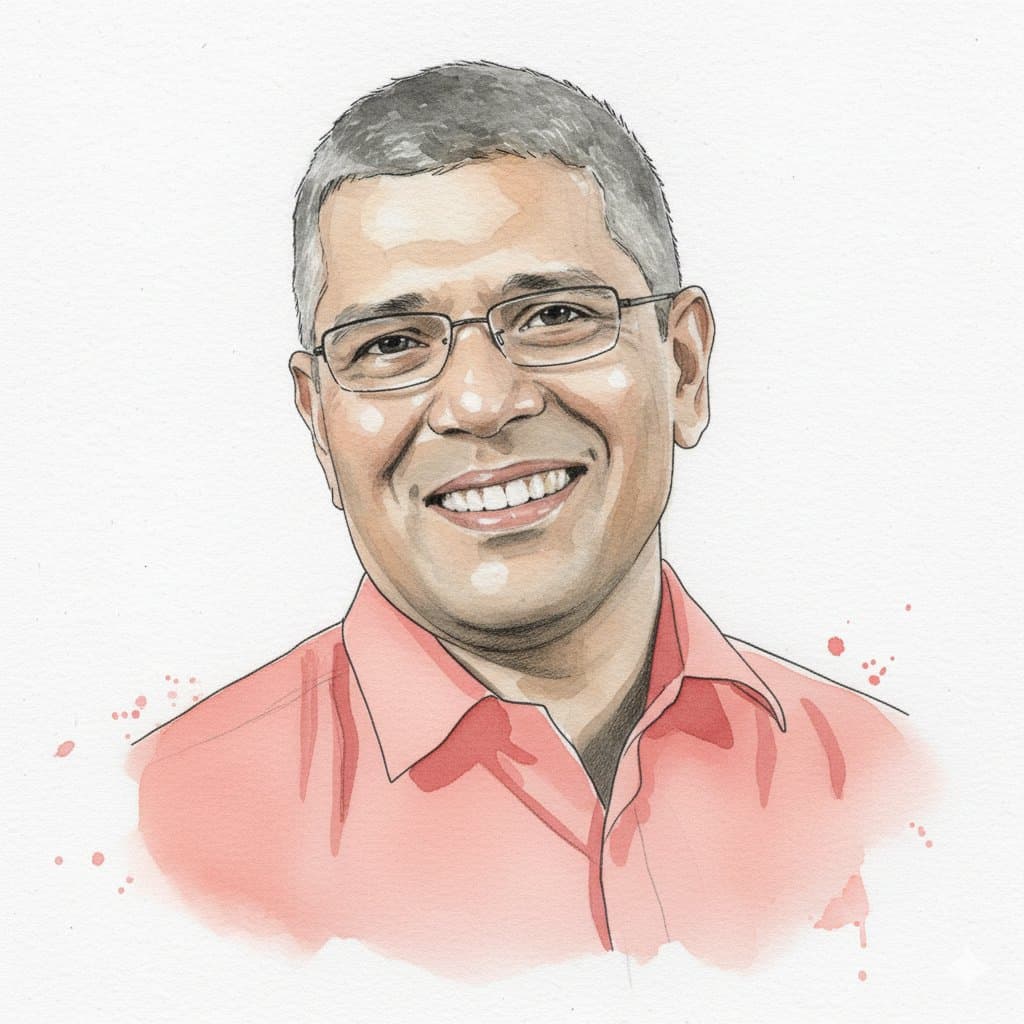
Prem Menon
Founder, Simpleworks Consulting. 39 years across Telecom, Automotive and Consumer Durables — now helping Indian MSME and family-business founders grow with clarity.