Why Retail and Distribution MSMEs in India Are Hitting a Wall — and How to Scale Through It
Most retail and distribution MSMEs in India are not running out of market — they are running out of model. The distribution strategy that built your first ₹20 crore is the same one blocking your path to the next.
Picture a distributor in Pune who built a ₹22 crore business over twelve years. His margins are tighter this year than last, even though he moved more volume. He has more stockists than ever, more SKUs than he can count, and more channel partners than he can manage. He is, by every surface measure, growing. And yet he feels like he is running faster to stay in the same place.
This is the wall that retail and distribution MSMEs in India are hitting right now. It is not a market problem. India's consumption story is intact. The organised retail sector is growing, quick-commerce is reshaping last-mile, and Tier-2 and Tier-3 cities are producing new demand faster than most brands can reach them. The opportunity is real.
The problem is that the model most retail and distribution MSMEs built to reach ₹10–30 crore — wide SKU catalogues, margin-thin volume plays, distribution networks held together by personal relationships — is the exact model that prevents them from reaching ₹50–100 crore. In retail consulting India MSME engagements, this is the pattern I see most often: founders who outgrew their model without realising it.
The Numbers Behind the Stall
India has approximately 13 million retail outlets and one of the most complex distribution ecosystems in the world. The typical MSME in this space operates through a multi-tier channel: company → super-stockist → distributor → retailer → consumer. Each tier extracts a margin. Each tier adds latency. Each tier creates a point of potential conflict.
According to a 2023 report by Technopak, margin pressure across the FMCG distribution chain has intensified significantly in the past three years. Distributor margins in competitive categories — personal care, packaged foods, household goods — have compressed from a historical average of 8–10% to 5–7% in many geographies, driven by direct-to-retail plays by large brands and the aggressive pricing models of quick-commerce platforms like Blinkit and Zepto.
For a ₹20 crore distributor running at 6% margin, this is not a rounding error. It is the difference between a sustainable business and one that is effectively moving rupees from one pocket to another. And the response most MSMEs reach for — more volume, more channels, more SKUs — tends to make the problem worse, not better.
Understanding why requires looking at three compounding dynamics that together form the wall.
The Margin Compression Trap in Indian Distribution Strategy
The first dynamic is the most counterintuitive: in retail and distribution, growth can destroy margin. Here is why.
As a distributor or retailer grows its channel footprint, it typically does so by adding lower-margin geographies, lower-margin trade classes (general trade vs. modern trade), or lower-margin SKUs to fill shelf space. Revenue grows. Gross margin percentage falls. And because the fixed cost base — warehouse infrastructure, field sales headcount, vehicle fleet — has to scale with the new volume, operating leverage does not materialise the way founders expect it to.
Think of it like a restaurant that responds to declining per-cover profitability by adding more tables. The covers go up. The kitchen gets overwhelmed. Service quality drops. And the per-cover economics get worse, not better, because the cost of complexity was never priced in.
The discipline required to break this trap is counterintuitive: shrink to grow. The distribution strategy consulting intervention here is to run a contribution margin analysis across every SKU, every customer class, and every geography — and then exit the ones pulling the average down. D-Mart, often cited as a distribution efficiency benchmark in Indian retail, built its model on brutal category curation: fewer SKUs, faster turns, no margin giveaways. MSMEs rarely have the conviction to do this, because revenue feels like safety.
It isn't. Margin is.
Channel Conflict: When Relationship-Built Distribution Becomes a Liability
The second dynamic is channel conflict, and it is the most emotionally charged because it touches the relationships that built the business.
Most distribution MSMEs in India were built on personal trust. A founder knew the key stockist in the district. He gave credit when others wouldn't. He showed up at weddings. The channel network is not just a business arrangement — it is a social one. And for the first decade, this is an enormous competitive advantage.
The problem emerges when the business tries to modernise its go-to-market approach. Modern trade requires different terms. E-commerce requires different pricing. Quick-commerce requires fulfilment infrastructure that the traditional distributor does not have. And the moment an MSME tries to serve all of these channels simultaneously, the traditional channel partner — who gave the founder a start — feels undercut. He is being asked to compete with a platform that buys direct, at prices he cannot match, for customers who used to be his.
This is not a theoretical problem. Hindustan Unilever faced a version of this when it launched its direct-to-consumer channels, and it is large enough to manage the fallout. An MSME with ₹25 crore in revenue and forty-year relationships cannot manage it the same way.
The resolution is not to avoid modern channels — the market will not allow that. The resolution is to segment deliberately. Different products, different price points, or different geographies for different channels, so that the new channel does not directly cannibalise the old one. This is what sound business strategy consulting for retail MSMEs looks like in practice: not grand strategy, but surgical segmentation.
The SKU Proliferation Problem: Width Is Not Strength
The third dynamic compounds the first two: most retail and distribution MSMEs have far too many SKUs, and the range keeps growing because saying no to a new product line feels like leaving money on the table.
It isn't. It is adding inventory carrying cost, warehouse complexity, salesforce attention dilution, and procurement risk — all of which erode the margin of the products that are actually working.
A 2022 Nielsen study of Indian FMCG distributors found that in a typical 500-SKU catalogue, 80% of gross profit is generated by fewer than 120 SKUs. The remaining 380 SKUs exist, consume working capital, and contribute to the illusion of scale without contributing meaningfully to the bottom line.
The MSME growth consultant's job here is to make this visible — because most founders have never seen their business this way. When you lay out gross profit contribution by SKU, the long tail becomes impossible to defend. The argument for curating the catalogue is not philosophical. It is numerical.
The Strongest Objection — and Why It Does Not Hold
The most common pushback I hear from founders when I raise these points is this: "If I reduce SKUs, I lose shelf space. If I exit certain channels, my competitors take the territory. I cannot afford to shrink. The answer has to be more scale, not less."
This is a genuinely reasonable concern. Channel relationships are real, territorial competition is real, and the fear of conceding ground to a competitor is rational. I do not dismiss it.
But here is what the data from comparable businesses shows. The distributors who doubled down on volume without fixing margin structure did not improve their economics over a three-to-five year horizon. The ones who took the painful decision to cull underperforming SKUs, renegotiate with loss-making channel partners, and segment their channel strategy by product — those businesses rebuilt their margin and then grew into new territories from a position of financial strength.
There is a version of "more scale" that works. But it works only after the underlying model has been restructured. Scaling a broken model faster does not fix the model — it compounds the damage.
The Path Through the Wall
The wall that retail and distribution MSMEs in India are hitting is not a market problem. It is a model problem. And the good news is that model problems are fixable.
The sequence matters. First, a rigorous margin analysis — by SKU, by customer, by channel, by geography — to understand where you are actually making money. Second, a channel segmentation strategy that lets you serve modern trade and e-commerce without burning the traditional channel. Third, an honest catalogue cull that focuses your salesforce, your working capital, and your operations on the products that are actually building the business.
None of this is comfortable. The moves that break through the wall require you to give things up — volume, SKUs, channel relationships that feel important even when they're unprofitable. But the alternative is to stay on the treadmill: more activity, thinner margins, slower growth, and the persistent feeling that the business is working harder than it needs to.
The founders who get through the wall are not the ones who add more. They are the ones who have the clarity — and the courage — to do less, better. If you're ready to work through that analysis, start here.
About Prem Menon
Prem Menon is the founder of Simpleworks Consulting, working with MSME founders and growth-stage businesses across India to turn strategy into execution. With experience spanning manufacturing, SaaS, retail, and professional services, Prem brings a practitioner's eye to the problems most consultants only theorise about.
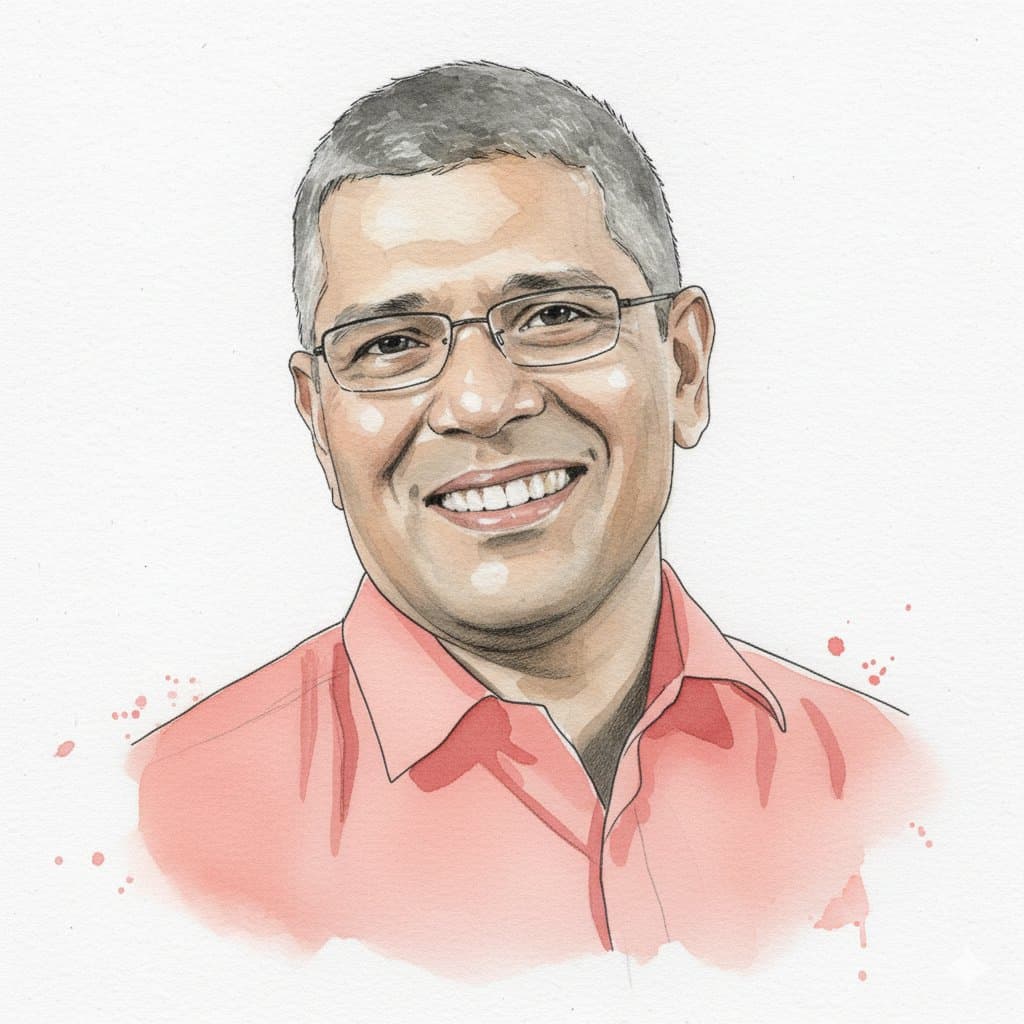
Prem Menon
Founder, Simpleworks Consulting. 39 years across Telecom, Automotive and Consumer Durables — now helping Indian MSME and family-business founders grow with clarity.