Why Most MSMEs Don't Need More Strategy — They Need Someone to Execute It
Most Indian MSMEs aren't stuck because of bad strategy — they're stuck because no one is executing the strategy they already have. This post diagnoses the execution gap, shows why traditional consulting makes it worse, and explains what closing it actually looks like in a founder-led business.
The founder of a mid-sized packaging manufacturer in Pune showed me his business plan last year. It was a well-structured 40-page document — market sizing, a SWOT matrix, growth targets, channel strategy, even a competitive positioning map. It had been sitting in his desk drawer for eleven months. Untouched.
As an MSME consultant India-based, I've seen versions of this scene more times than I can count. The strategy isn't the problem. The execution gap is. And closing that gap is the most valuable thing a management consultant can do for a founder-led business today.
The Strategy Paradox in Indian MSMEs
Most founders believe the biggest obstacle to growth is strategic clarity. "We don't know which market to target." "We haven't figured out the right product mix." "We need a better go-to-market plan."
So they hire consultants who write more strategy. They attend workshops. They build decks. They revise their annual plans.
But if you look at the data, it tells a different story. According to a 2023 SIDBI report on MSME growth barriers, fewer than 30% of Indian MSMEs cite "lack of strategy" as their primary constraint. The overwhelming majority point to operational bottlenecks, team alignment failures, and the inability to hold people accountable across functions.
This is the strategy paradox: the more strategy an organisation produces without execution capability, the more confident it becomes that its problems are strategic.
They are not.
What the Execution Gap Actually Looks Like
The execution gap isn't about laziness or incompetence. It's a structural problem that emerges when a business scales past the point where the founder can personally drive every outcome.
In a 10-person business, the founder is the strategy, the manager, and the executor all at once. They know every customer, every supplier, and every daily priority. Execution happens because they're there.
At 40 or 50 people, that model breaks. Layers appear. Communication gets attenuated. The founder's priorities don't reach the front line in the same form they were issued. Teams work hard on the wrong things. Nobody means for this to happen — it's what growth looks like when it outpaces operating systems.
This is where strategy execution consulting India practitioners see the same patterns playing out across sectors — manufacturing, retail, professional services. The symptoms are consistent: missed quarterly targets that get revised rather than investigated, a culture where "almost done" is a permanent status, and meetings that produce action items nobody follows through on.
Tata Group's Titan Company, in its early years of scaling distribution, faced this exact challenge. The strategy was clear: premium retail for watches in a market dominated by unorganised trade. The execution challenge was building a network of franchisees who could actually deliver a premium experience. The strategy didn't change. The operating model and execution cadence did. That's what unlocked growth.
Why Business Strategy Consulting India Often Gets This Backwards
Most business strategy consulting India engagements are designed to produce documents. A diagnostic report. A three-year roadmap. A restructured operating model on paper. These are real outputs, and sometimes they're necessary.
But a document is not a result.
The failure mode I see most in traditional strategy engagements is what I call "the handoff assumption" — the idea that once the strategy is delivered, the client's team will figure out how to execute it. This assumption is almost always wrong for an MSME with a founder who hasn't yet built strong second-line leadership.
What an MSME consultant India actually needs to do is stay inside the execution long enough to make sure it happens. That means working with the team to set priorities that survive the first contact with the week's reality. It means building the rhythms — weekly reviews, escalation protocols, honest progress tracking — that most founder-led businesses have never had. It means being the person who asks "why didn't that happen?" and expects a real answer.
This is fundamentally different from traditional management consulting, where the deliverable is advice. In MSME work, the deliverable is change.
Connect with Simpleworks Consulting if you want to understand what a hands-on engagement actually looks like — as opposed to a strategy report that lives in a drawer.
The Counter-Argument: Strategy Does Matter
A fair objection: isn't this overstated? Don't businesses fail from bad strategy all the time?
Yes. They do. A technically excellent execution of the wrong strategy is still failure — possibly faster failure, because the wrong direction gets pursued with discipline.
There are moments when strategy is genuinely the bottleneck. A business operating in a market that's structurally declining needs to rethink the arena, not just the execution. A company that's been outmanoeuvred by a competitor with a structurally lower cost base needs to make hard strategic choices, not just hustle harder.
The nuance — and this is where many founders get stuck — is that most MSMEs are nowhere near that scenario. They're operating in viable markets, with viable products, with an existing customer base. Their problem isn't that they have the wrong strategy. Their problem is that the strategy they have never gets implemented consistently enough to know whether it works.
In 39 years of working with Indian businesses across manufacturing, SaaS, consumer durables, and professional services, I've found that roughly 80% of the stuck businesses I've encountered had enough strategic clarity to succeed. They were missing the discipline and the operating cadence to turn that clarity into outcomes.
That's an execution problem, not a strategy problem.
What Closing the Gap Actually Looks Like
Closing the execution gap isn't heroic. It's boring, persistent work.
Setting priorities that the whole team understands — not a 40-point action plan, but five things this quarter that actually matter.
Building a weekly rhythm where progress is tracked honestly, not reported optimistically.
Putting accountability in place — real accountability, where missing a commitment has a consequence and achieving one is acknowledged.
And creating the space for the founder to stop being the execution system and start being the leader.
That last part is the hardest. Most founder-led businesses are built on the founder's energy. Moving to a model where the organisation executes independently requires the founder to let go — and to trust systems they haven't yet built.
As a management consultant India for MSME businesses, the most transformative thing I do isn't the strategy. It's helping the founder see that the business they've built can run without them in every room — if the right systems are in place.
The Only Question Worth Asking
If you're an MSME founder reading this with a strategy document you're proud of, ask yourself one question: What has actually changed in the last six months because of it?
Not planned. Not discussed. Not on the roadmap for Q3. Changed.
If the answer is "not much," you don't need more strategy. You need someone to help you execute the strategy you already have.
That's a solvable problem. And it's the one worth solving next.
About Prem Menon
Prem Menon is the founder of Simpleworks Consulting, working with MSME founders and growth-stage businesses across India to turn strategy into execution. With experience spanning manufacturing, SaaS, retail, and professional services, Prem brings a practitioner's eye to the problems most consultants only theorise about.
Ready to close the gap between strategy and execution?
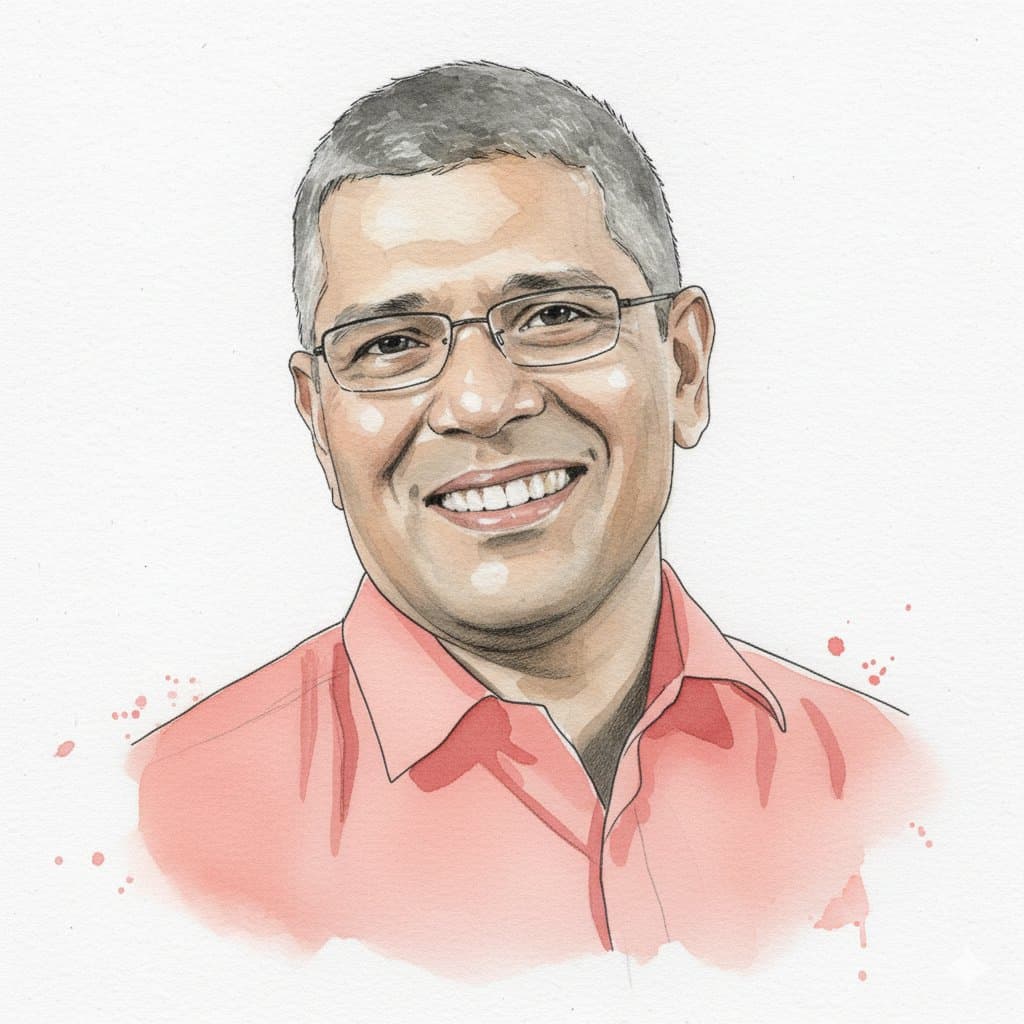
Prem Menon
Founder, Simpleworks Consulting. 39 years across Telecom, Automotive and Consumer Durables — now helping Indian MSME and family-business founders grow with clarity.