Why Founder-Led Sales Breaks After Series A — And What Replaces It
The GTM motion that closed your first ₹2 crore ARR was built around you — your credibility, your context, your closing power. Here's why that motion breaks after Series A, and the three-part system that replaces it.
There is a particular kind of founder who closes deals brilliantly. They know the product inside out. They understand the customer's problem better than the customer does. They are credible, urgent, and difficult to say no to. That founder takes the company from zero to ₹2 crore ARR, sometimes ₹5 crore, almost entirely on personal selling power.
Then they raise a Series A. Hire a sales team. And watch pipeline dry up.
The diagnosis most founders reach at this point is the wrong one. They assume the new team cannot sell. They step back into deals themselves. They create a dependency they were supposed to be eliminating. The real problem is not the team. It is that the GTM motion that got the company to ₹2 crore ARR was built around a specific person — and that motion, by design, cannot be handed to anyone else.
As a go-to-market consultant India-wide, this is one of the most consistent failure points I see in growth-stage startups. This post explains exactly why founder-led sales breaks, what it needs to be replaced with, and how to make the transition without losing the pipeline you already have.
Why Founder-Led Sales Works So Well — Until It Doesn't
Founder-led sales works because of an asymmetry that is almost impossible to replicate. The founder has context no salesperson will ever have at the start: the origin story, the product roadmap, the ability to make real-time concessions on pricing or features, and the emotional investment that reads as conviction in a sales room.
When a founder is in the room, the customer is not just buying a product. They are betting on a person. That bet is easier to make when the person across the table built the thing, believes in it unreservedly, and has the authority to make commitments on the spot. Early-stage B2B sales in India, particularly in SaaS and professional services, run almost entirely on this dynamic.
The problem is not that this stops working. Founder-led sales keeps working — for the founder. What stops working is the assumption that what the founder is doing is a process that can be documented, trained, and scaled. It is not. It is a performance. And performances do not transfer.
The numbers make this concrete. A founder with 40% of their time allocated to sales can realistically manage 8–12 deals at any given moment. At ₹15–20 lakh average contract value, that ceiling is somewhere around ₹1.5–2.5 crore ARR. To get to ₹8 crore, you need to either clone the founder — which is not on the product roadmap — or build a system that does not require them.
The 3 Specific Reasons Founder-Led Sales Breaks After a Funding Round
1. The bandwidth ceiling becomes structural.
Before the raise, the founder's involvement in sales was the ceiling. After the raise, the board expects 3–4x revenue growth. The founder is now also managing new hires, investor relations, product decisions under more scrutiny, and the organisational complexity that comes with a team that has just doubled. The hours available for direct selling do not increase — they collapse. A go-to-market consultant called into a post-Series A startup will almost always find the same scene: a founder trying to keep the sales motion alive personally while everything else burns.
2. The motion is in the founder's head, not in the system.
Ask most founders to write down their sales process and they will describe a sequence of steps that sounds logical on paper but leaves out everything that actually works: the specific framing they use when a prospect raises a pricing objection, the way they qualify out a bad-fit customer in the first ten minutes, the stories they tell in slide three that shift the room. That tacit knowledge took years to accumulate. It cannot be downloaded into a new hire in a two-week onboarding.
Freshworks — now a public company — is an instructive example at scale. Girish Mathrubootham was famously close to early enterprise deals and the Freshworks sales culture grew directly out of that proximity. What made Freshworks scale was not trying to replicate Girish in every AE — it was building a system that captured the ICP rigour, the objection handling, and the qualification framework, and then letting people work within that system rather than improvising their way through it.
3. New hires calibrate to the wrong signal.
When a founder stays close to sales after hiring a team, the team learns the wrong lesson: that their job is to bring opportunities to the founder, not to close them. Every time the founder steps into a deal "just to help," the new hire loses a closing repetition they will not get back. Over six months, the team becomes skilled at qualifying and setting up calls, and dependent on the founder for everything after. The founder has not built a sales team. They have built a pipeline generation team with themselves as the bottleneck closer.
What Replaces Founder-Led Sales: The GTM System a Startup Actually Needs
The replacement is not a VP of Sales. It is a system — and the VP of Sales, if you hire one, is the person who runs the system, not the person who invents it. That distinction matters because most Series A startups hire the VP of Sales expecting them to build the system from scratch, give them six months, and then let the founder go back to product. That almost never works. The VP needs inputs that only the founder has: a defined ICP, a validated value proposition, a documented sales motion, and a clear sense of what a winnable deal looks like.
Component 1: A rigorous ICP definition — not a persona, a profile.
Most startups have a target customer persona. Very few have a true ICP. The difference: a persona is a demographic sketch ("mid-sized SaaS company, 50–200 employees"). An ICP is a set of conditions that, when present, make a deal winnable without the founder's involvement. It answers: what is the trigger that makes this customer actively looking? What does the internal champion look like? What is the deal-breaker that means we should walk away in the first call?
The ICP only exists in clear form after the founder has lost deals and analysed why. The best source for it is closed-lost analysis — not brainstorming, but structured retrospectives on the 30–40% of pipeline that got to proposal stage and did not close. That data tells you more about your real ICP than any persona workshop.
Component 2: A sales process with exits, not just stages.
Most CRMs have a pipeline with stages: Qualified → Demo → Proposal → Negotiation → Closed. That is a reporting structure, not a process. A real sales process defines what has to be true at each stage before a deal can move forward — and what conditions trigger an exit. "Qualified" means the buyer has confirmed budget, authority, need, and timeline — not that they agreed to a demo call. Without explicit exits, deals accumulate in the pipeline and the team's time is distributed across stale opportunities instead of concentrated on winnable ones.
Component 3: The right first sales hire — not the most experienced one.
For most startups building their first scalable sales function, the instinct is to hire the most senior salesperson they can afford post-raise. This is usually the wrong call. A senior enterprise sales hire from a large company brings process discipline but not the scrappiness, ambiguity tolerance, and founder-proxy credibility the role needs in the ₹5–15 crore ARR stage. The profile that actually works: someone who has sold in a founder-led environment before, understands that they will be building the playbook as they go, and has enough seniority to own a deal end to end without needing a founder in the room.
How to Make the Transition Without Killing the Pipeline You Have
The transition from founder-led to system-led sales has to be managed as a deliberate GTM handover — not as a clean break. A clean break means the founder stops selling on Monday and the new team takes over. That produces a 60–90 day pipeline gap that a startup at Series A cannot absorb.
The right model is a co-selling phase: the founder stays in deals as a resource, not as a driver. The new AE owns the relationship, runs the discovery, and proposes the solution. The founder is available for a 20-minute call at a specific deal stage — say, at contract discussion — not as the default closer, but as a signal of commitment to the customer. That distinction matters. It protects the relationship dynamic that made founder-led sales powerful while gradually shifting the ownership.
Simultaneously, the founder documents obsessively during this phase. Every deal that closes: what was the trigger, what was the objection, what story closed it. Every deal that is lost: what was missing, where did the qualification break down, what would have had to be true for it to close. After 15–20 deals documented this way, the pattern is visible enough to build a real playbook.
The co-selling phase should last no more than three months. Beyond that, it stops being a transition and starts being a permanent crutch.
The Counter-Argument: "But Our Customers Expect to Talk to the Founder"
This is the most common objection — and the most seductive one, because it is partially true. In certain categories — enterprise SaaS, high-touch consulting, government contracts — the founder's direct involvement signals seriousness that a sales hire cannot replicate immediately. Customers who have dealt with startup sales cycles before know that access to the founder is a proxy for access to decision-making, flexibility on terms, and a faster path to resolution when things go wrong.
The right response to this is not to ignore the dynamic — it is to productise it. Create a specific touchpoint in the sales process where the founder is present: a 30-minute "technical and strategic alignment" call that happens at a defined stage, for deals above a defined size. That touchpoint is real, valuable, and scalable because it is bounded. It is categorically different from the founder being the default closer on every deal above ₹15 lakh.
The danger in "our customers expect the founder" is that it becomes a reason to never make the transition. Five years later, the company is still founder-dependent in its sales motion, the team has learned not to close, and the founder is exhausted. The fact that some customers prefer founder access does not mean that the sales system should be built to accommodate that preference indefinitely.
The Transition Is About Clarity, Not Capability
The founders who get this transition right are not the ones with the best sales hires or the most sophisticated CRMs. They are the ones who are honest — early — about what they are actually doing when they sell, and who build the rigor to capture it before they need to hand it off.
Founder-led sales breaks not because the founder stops being good at selling. It breaks because the business outgrows the bandwidth of one person. The system that replaces it is not a surrender of what made the company's sales powerful in the early days. It is a deliberate codification of it — precise enough that someone else can use it, flexible enough that it improves with every deal.
If you are at the stage where pipeline depends on your personal involvement in every deal, the time to build the replacement system is now — not after you hire the VP of Sales, not after the next funding round. The system takes three to six months to stabilise. By the time you feel the urgency, you are already three months behind.
About Prem Menon
Prem Menon is the founder of Simpleworks Consulting, working with MSME founders and growth-stage businesses across India to turn strategy into execution. With experience spanning manufacturing, SaaS, retail, and professional services, Prem brings a practitioner's eye to the problems most consultants only theorise about.
Ready to build a sales system that closes without you in the room?
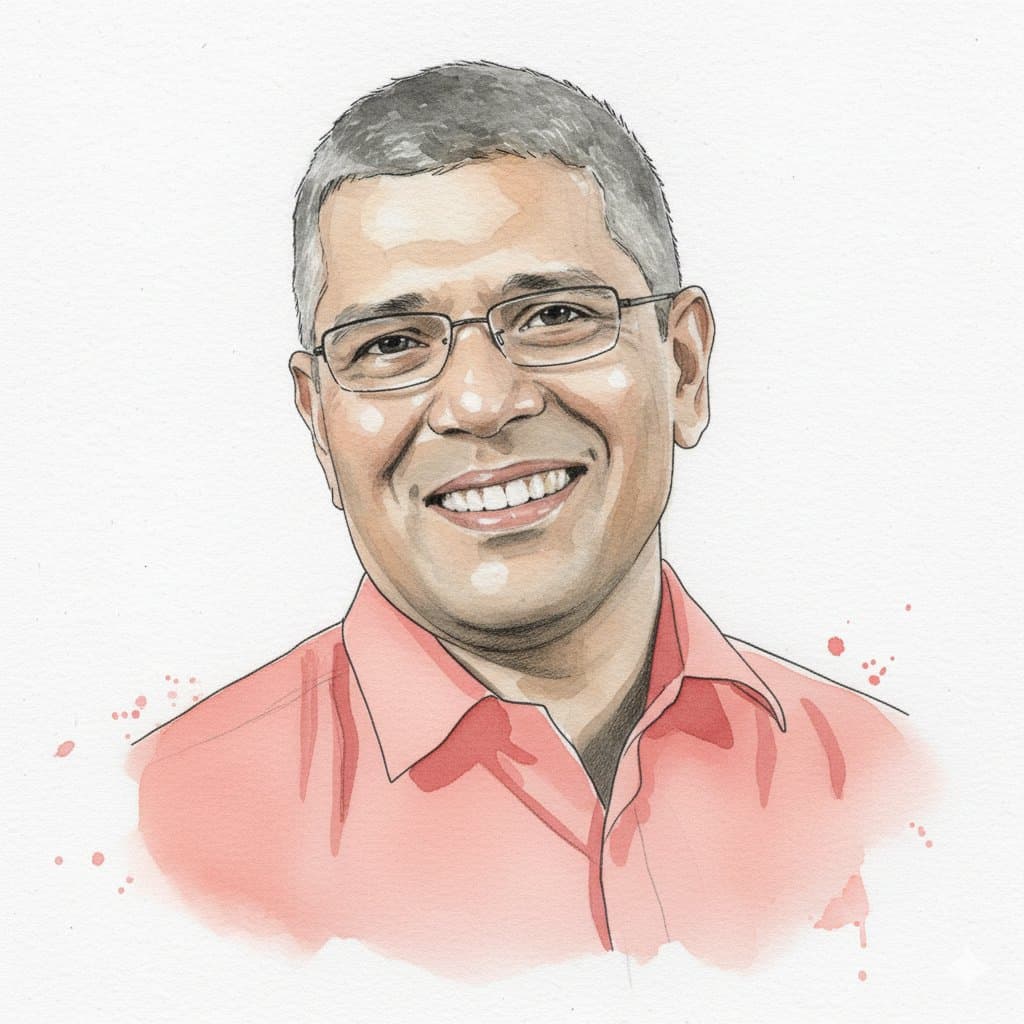
Prem Menon
Founder, Simpleworks Consulting. 39 years across Telecom, Automotive and Consumer Durables — now helping Indian MSME and family-business founders grow with clarity.