Simplicity Is Not a Strategy. It's a Way of Being That Eventually Becomes One.
Most business owners who want a simpler business start by restructuring the business. That's the wrong end — simplicity flows inside out, from the individual who builds the editing instinct, to the leader who multiplies it, to the business that finally holds it.
Most business owners who want to simplify their business start by reorganising the business. They restructure teams, cull the product range, streamline processes, implement new systems. Some of it helps. Most of it doesn't last. Within six months, the complexity is back — different in shape, identical in weight.
The reason is not a lack of discipline or the wrong framework. The reason is sequence. They started at the wrong end.
Simplicity does not begin in the business. It begins in the person. And between the person and the business sits a third level that most people never examine — the business person: how they lead, communicate, and make decisions in the space between their internal world and the organisation they are building.
There are three distinct levels at which simplicity must be cultivated, and they have a fixed order. Get the sequence wrong, and the frameworks — however good — are being applied to a foundation that cannot hold them. The sequence is: the individual first, the business person second, the business third. Inside out, not outside in.
This is what business strategy consulting in India reveals most consistently: the businesses that are hardest to simplify are not the most complex organisations. They are the ones led by people who have never done the internal work. And the businesses that simplify most durably are almost always the ones where the founder changed first.
Level One: The Individual — Simplicity as a Way of Being
Before simplicity is a business strategy, it is a personal condition. And it is rare — because the default condition of most professionals is not simplicity but accumulation.
We accumulate information, because knowing more feels safer than knowing less. We accumulate commitments, because saying yes feels more generous than saying no. We accumulate opinions, because having a view on everything signals intelligence. We accumulate goals, because ambition is celebrated and restraint is mistaken for a lack of it. None of this is irrational. Each individual act of accumulation makes sense. Together, they produce a mind that cannot hold a single clear thought for more than a few minutes without it being crowded out by the next thing.
The ancient Stoics called the goal ataraxia — a state of mental calm achieved not by having more but by wanting less. Not poverty of aspiration, but clarity of it. Knowing precisely what you are for, so that everything else can be released without loss.
For a modern professional, building this condition is daily work. Here is what that work actually looks like:
The Single Daily Question
Before anything else — before email, before the calendar, before the news — one question: what is the one thing I must do today that makes everything else easier or less necessary? Not a to-do list. One thing. The discipline of answering this question honestly, every day, trains the mind to rank before it lists. Most professionals list first and never rank at all.
The Stop-Doing List
Alongside every weekly plan, one item is added to a stop-doing list. A commitment that no longer serves. A habit that consumes time without producing meaning. A relationship being maintained out of obligation rather than value. Over months, this practice builds the editing reflex — the instinct to remove, not only to add. Without this list, the to-do list expands indefinitely and the week fills with things that were never consciously chosen.
The Pause Before Adding
Before accepting any new commitment — a meeting, a project, a responsibility — a single pause: if I say yes to this, what will I remove to make space for it? This question does two things. It makes the cost of addition visible before it is paid. And it trains the individual to treat their attention as a finite resource that requires active management, not a blank account that can absorb whatever arrives.
The Feynman Test
Richard Feynman's rule was simple: if you cannot explain something simply, you do not understand it well enough. Applied personally, this becomes a daily clarity check. If you cannot explain your current priority in one sentence, you do not yet know what you are doing or why. That is useful information to have before you spend a day on it.
These are not productivity hacks. They are practices for building what you might call an editing identity — the internal shift from seeing yourself as someone who adds value by knowing more things to someone who adds value by knowing what matters. That shift is the foundation. Without it, the next two levels will not hold.
Level Two: The Business Person — Simplicity in How You Lead
The individual who has not done the internal work becomes, as a business person, a source of complexity for everyone around them. They are in every meeting because they do not trust decisions made without them. They give long, hedged answers because they have not decided what they actually think. They create work for their team by changing direction frequently, because their own priorities are not settled. They are, in the precise sense of the word, a bottleneck: everything that requires a decision slows down at the point where it reaches them.
The individual who has done the internal work becomes something different: a multiplier. Their clarity creates clarity downstream. Their decisiveness creates momentum. Their willingness to trust people with authority creates capacity. The organisation moves faster not because they are working harder, but because less of the organisation's energy is spent managing the uncertainty they generate.
The business person's simplicity lives in three specific disciplines:
Simple Communication
Complex thinkers communicate complexly — long emails, qualified statements, presentations with twenty slides when five would do. Simple thinkers communicate with signal. They state the decision, not the deliberation that preceded it. They give the direction, not every consideration that shaped it. This is not about withholding information. It is about respecting that most people need to know what to do, not everything that went into deciding it.
The practice here is ruthless editing of your own communication before it leaves you. Every email that is longer than three sentences is a candidate for reduction. Every meeting agenda longer than three points is a candidate for simplification. The question is always: what does this person actually need from me, and have I given them that — without the rest?
Fast, Final Decisions
The business person who cannot make decisions — or who makes decisions and then reopens them — creates a specific kind of organisational exhaustion. People stop bringing problems forward because they have learned that resolution is unlikely. They start working around the decision-maker rather than through them. The organisation begins to move on informal consensus rather than clear authority, which is slower, less accountable, and almost impossible to scale.
Simple decision-making is not reckless decision-making. It is disciplined decision-making: clear about which decisions require which level of input, willing to decide with imperfect information when waiting for perfect information costs more than the decision itself, and — critically — willing to let a decision stand once made. The leader who revisits every decision is not being thorough. They are signalling that their decisions are not actually decisions.
Trusting People to Act
The simplest thing a business person can do for their organisation is to be genuinely unnecessary for routine operations. This requires two things most business owners find uncomfortable: a clear articulation of the principles within which people can act without asking, and the discipline not to override those people when they act within those principles in a way that is different from how the owner would have acted.
As a business mentor for founders across India, the conversation I have most often is this one: the founder has built a business that cannot function without them, and they are simultaneously proud of being needed and exhausted by the need. The exit from that trap is not a delegation framework. It is the willingness to let go — which is, at its core, a personal practice before it is a managerial one.
Level Three: The Business — Simplicity in What You Build
When the individual has built the editing instinct, and the business person has built the clarity of leadership, the organisation becomes capable of absorbing simplification. Not before. This is why restructuring initiatives led by complex thinkers almost always revert: the organisation was changed, but the person who runs it was not.
At the business level, simplicity has three domains.
What You Offer
Most businesses have more products, services, or customer types than are justified by the returns they generate. A rigorous 80/20 analysis — mapping every offering against its actual contribution to gross profit — will almost always reveal that a small number of things are producing the overwhelming majority of value, and a large number of things exist because removing them feels riskier than keeping them.
The discipline is not to eliminate breadth for its own sake, but to hold every offering to the same standard: is this earning its place in the business, or is it consuming attention, inventory, and management energy that our best products deserve more of? The answer is usually uncomfortable. Act on it anyway.
How You Operate
Operational complexity accumulates the same way personal complexity does: one reasonable decision at a time. Each approval layer was added for a reason. Each report was created because someone needed visibility. Each meeting was scheduled because coordination seemed important. Together, they form a bureaucracy that nobody designed but everyone maintains, because removing any individual piece requires confronting the reason it was added.
The discipline Toyota built into its production philosophy under the concept of Muda — waste — is directly applicable here. Waste is any activity that consumes resources without adding value for the customer. Applied to processes, the question becomes: if we removed this step, what bad thing would actually happen? In most businesses, honest application of this question eliminates a third of existing processes without any meaningful risk. The strategy execution work that makes the most lasting difference is rarely adding new systems. It is removing the old ones that nobody has had the courage to question.
How You Decide What Matters
A business that is simple at the operational level but has no clarity about strategic priorities will regenerate complexity immediately, because without a clear centre of gravity, every new opportunity looks equally attractive and every new problem equally urgent. Strategic simplicity means the organisation has a clear answer to three questions: who are we for, what do we do better than anyone else, and what will we not do regardless of the opportunity it represents? The third question is the hardest and the most important. A business that cannot answer it will expand its scope indefinitely and dilute its strength at exactly the moment it should be deepening it.
The Objection — and Why It Misses the Point
The most common resistance to this argument sounds like this: "Simplicity is a luxury. When you are fighting to survive, you cannot afford to be selective. You take every customer, every product, every opportunity."
There is truth in this — in the very earliest stage of a business, when the question is simply whether the model works at all, breadth is a legitimate form of experimentation. But this objection is almost always made by people who are well past that stage, using an early-stage justification to avoid a growth-stage discipline.
The harder truth is that simplicity is not a luxury of those who have made it. It is a prerequisite for making it. The businesses that plateau are not, in most cases, the ones that ran out of opportunity. They are the ones that ran out of clarity — about what they were building, why, and for whom. And they ran out of clarity because the people leading them never built the practice of simplicity as a personal discipline. The business reflected the mind that built it.
The Sequence Is Everything
Leonardo da Vinci wrote that simplicity is the ultimate sophistication. He was not describing a style. He was describing the end point of a long process of refinement — the moment when everything unnecessary has been removed and what remains is only what must be there.
For a business owner, that process of refinement has to begin inside. With the daily practice of the individual who edits their attention before they edit their calendar. With the business person who communicates clearly, decides finally, and trusts genuinely. And only then, with the business that reflects that clarity in what it offers, how it operates, and what it has chosen not to do.
The sequence is not optional. An organisation can be simplified without the person changing, but it will not stay simple. The complexity will return in a new form, because the system that generates it has not changed.
Simple is hard. It is the hardest sustained discipline in professional life. But it is also the one that compounds most reliably — in a clearer mind, a more effective leader, and a business that holds its shape under pressure rather than expanding into chaos.
Start with yourself. The business will follow.
About Prem Menon
Prem Menon is the founder of Simpleworks Consulting, working with MSME founders and growth-stage businesses across India to turn strategy into execution. With experience spanning manufacturing, SaaS, retail, and professional services, Prem brings a practitioner's eye to the problems most consultants only theorise about.
Ready to work through what simplicity looks like for you, your leadership, and your business?
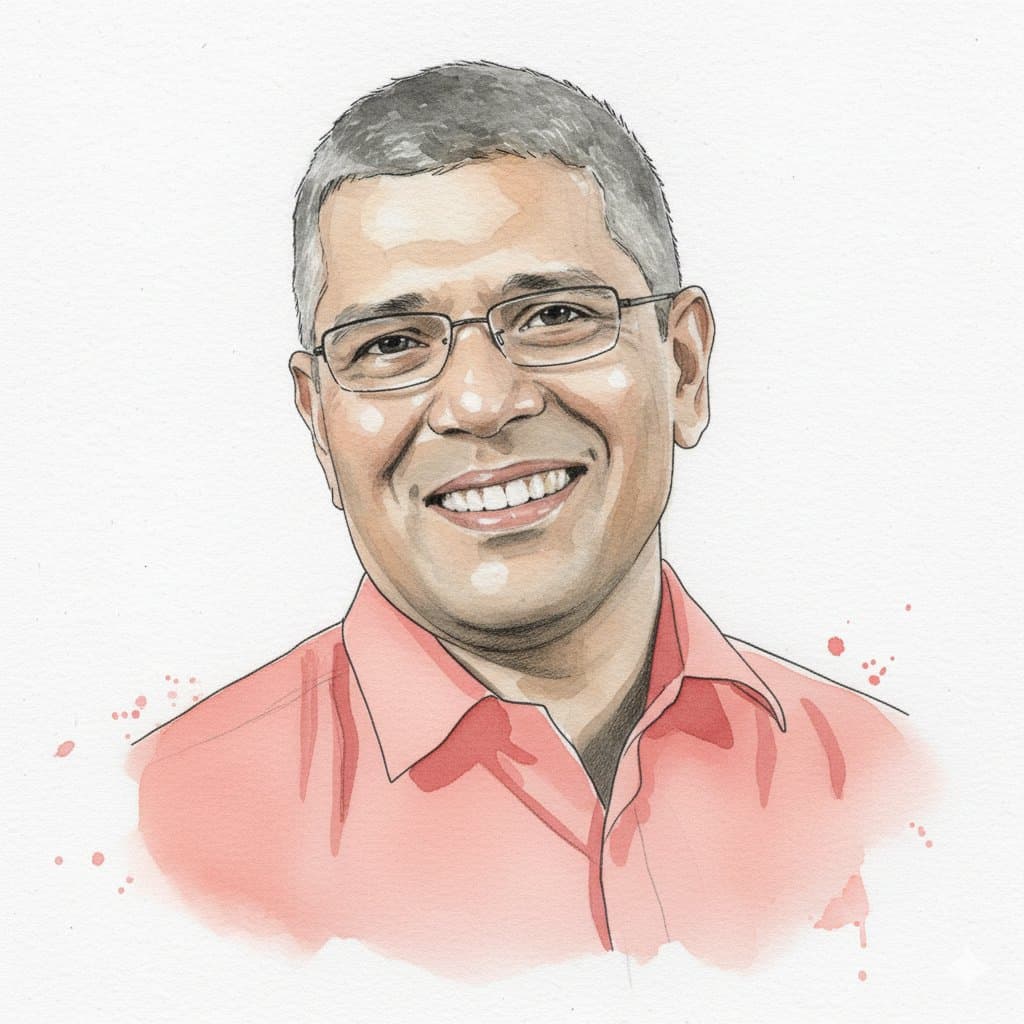
Prem Menon
Founder, Simpleworks Consulting. 39 years across Telecom, Automotive and Consumer Durables — now helping Indian MSME and family-business founders grow with clarity.