Is Your Family Business Ready for the Next Generation? 5 Hard Questions Every Owner Must Answer
80% of Indian family businesses don't survive to the second generation. The reason isn't an unprepared next generation — it's an unprepared business.
80% of India's businesses are family-owned. Only 30% survive into the second generation. And by the third, the odds are even worse.
The conventional explanation is that the next generation is unprepared — too entitled, too distracted, too far removed from the grit that built the business. But after working with family businesses across India, I've come to believe this diagnosis is wrong. Most family businesses don't fail because the next generation is unready. They fail because no one ever prepared the business — its structure, its governance, its leadership culture — to receive them.
Family business succession planning in India is too often treated as a legal event — the will, the shareholder agreement, the trust deed. These matter. But they come last. The work that determines whether a transition succeeds or fails happens years earlier, in five questions that most owners never ask themselves honestly.
Why Generational Transition Is a Leadership Problem, Not a Legal One
The 'shirtsleeves to shirtsleeves in three generations' pattern is real. It holds across cultures — the Japanese call it 'rice paddies to rice paddies,' the Chinese have their own version, and every Indian family business community knows some variant of it. The statistics don't lie.
But the pattern is misread. Most people look at it and see a failure of the third generation. I look at it and see a failure of the first and second — specifically, a failure to build the systems, the governance, and the leadership culture that would give the next generation a real chance.
Consider Bajaj Auto. When Rajiv Bajaj took over from Rahul Bajaj, his first move was to discontinue the Chetak scooter — a product that had been synonymous with the Bajaj name for decades. It was a radical, painful decision. But Rajiv had a thesis: the next decade belonged to motorcycles. He was right. Bajaj's Pulsar line redefined the Indian two-wheeler market. That kind of generational transition — disruptive, principled, successful — doesn't happen by accident. Rahul Bajaj stepped back at his peak. He created space for a successor with a different vision. That is what good succession looks like.
Now contrast that with the majority of family businesses, where the patriarch holds on indefinitely, the next generation has never been allowed to lead anything significant, and the 'transition plan' is the father's will. That is not succession planning. That is a recipe for conflict.
So before you reach for a lawyer or a CA, ask yourself these five questions. They will tell you more about your succession readiness than any legal document.
Question 1: Have You Groomed Your Successor — or Just Assumed They'd Figure It Out?
Here is a question worth sitting with: if your child has been working in the business for five or ten years and still isn't ready to lead it, who is responsible for that?
Grooming a successor is not the same as giving them a job title. It means deliberate exposure — to different functions, different challenges, different types of decisions. It means letting them make mistakes and face consequences. It means giving them real authority over something that matters, not just operational tasks with you hovering over every decision.
There is a pattern I see repeatedly: the patriarch sends their child abroad for an MBA, brings them back, puts them in charge of a plant or a function — and then proceeds to override every decision they make. The child learns nothing except that their authority is not real. Employees read this immediately. They take their cues from the owner, not the heir. The next generation then gets blamed for being 'unable to command respect' — when in fact, they were never given the conditions to earn it.
The advice I'd give any next-generation owner: ask your parent for three genuine chances. Not a title — chances. Three real attempts to run something, with the freedom to fail and pivot. The big empires were all built on failure. The question is whether your family business gives the next generation the same licence to experiment that the first generation gave themselves.
Question 2: Is There a Written Family Constitution, or Are You Running on Assumptions?
Every family I have worked with believes they have a shared understanding. Almost none of them do.
A family constitution — sometimes called a family charter — is not a legal document. It is a written agreement that defines how the family will function as both a family and a business. It covers: who is eligible to work in the business, how roles and salaries are determined, what expenses are paid from the business versus personal accounts, how decisions are made, and what happens when family members disagree.
Without this document, every family dispute eventually becomes a business dispute. I know of a family — three brothers, a combined business worth hundreds of crores — that spent an entire night, 11 pm to 4:30 in the morning, arguing about which car each brother was entitled to. The fight was not about the car. The fight was about everything the car represented: fairness, status, whether one brother was valued more than the other. These fights happen because the rules were never written.
The Apollo Hospitals group handles this differently: they use a rotational chairmanship, with each family member leading for a defined period. It is not a perfect system, but it is a written system. The rules exist before the conflict. That changes everything.
At Simpleworks, we help family businesses build governance frameworks that include a family constitution as a core deliverable — not as a one-time exercise, but as a living document that is reviewed and updated as the family grows.
Question 3: Are You Holding On Because the Business Needs You — or Because You Need It?
This is the hardest question. It requires a level of self-honesty that very few people manage.
The patriarch who built a business from nothing has, in many cases, given everything to it. The business is not just their livelihood — it is their identity. The chair at the head of the table is not just a management position. It is proof of who they are.
So when a consultant or a child says 'it's time to step back,' what the patriarch often hears is: 'you are no longer needed.' That fear of irrelevance — not stubbornness, not greed — is what drives most of the destructive behaviour we see in family business transitions. The 80-year-old patriarch who still signs every cheque. The founder who overrides the CEO they themselves hired. The father who said 'it's all yours' but never gave up a single decision-making authority.
Rahul Bajaj stepped back at his peak. Ratan Tata created a professional management structure that allowed the Tata Group to thrive long before his retirement. These are not stories about people who were forced out — they are stories about people who understood that the greatest act of leadership is building something that does not depend on you.
Ask yourself honestly: are you working for the business, or are you working for self-glory? The answer determines whether your legacy survives you.
Question 4: Does Your Business Have Governance That Functions Without You in the Room?
In India, 63% of family businesses own 70% of their own equity. Which means the board of directors, in most cases, is made up of the owner's brother-in-law, his uncle, and an old friend. That is not a board. That is an audience.
A business that cannot function without its founder making every significant decision is not a business — it is a job. A very large, very lucrative job, but a job nonetheless. The moment the founder steps back, or falls ill, or dies, it collapses. The next generation inherits not a business but a dependency.
Governance, in a family business context, means three things:
First, a board or advisory structure with at least some members who will tell you things you don't want to hear. Not yes-men. Not the Chamcha who agrees with everything. People with the standing and the courage to say 'this decision is wrong.' Think of Krishna in the Mahabharata — not the one who flatters, but the one who advises honestly, even when it is uncomfortable.
Second, defined KPIs and a review process. Only 30% of Indian family businesses clearly define, document, and track their KPIs, according to research by PwC, KPMG, and BCG. The companies that have survived three generations — Tata, Godrej, Bajaj — all have robust management information systems. Numbers are reviewed regularly. Accountability is built into the structure, not dependent on the patriarch's presence.
Third, a delegation of authority matrix. If your CEO cannot hire an executive without your approval, you have not hired a CEO — you have hired an expensive messenger.
If you are not sure how to build this, we can help.
Question 5: Do You Have a Defined Exit Policy — for Yourself and for Anyone Who Wants Out ?
One certainty in business — in life — is death. The patriarch who does not plan for their own exit is not protecting the business. They are leaving a bomb for their family to defuse under pressure, while grieving.
An exit policy covers two scenarios. The first is the founder's retirement or death — who takes over, on what authority, under what governance structure. The second is what happens when a family member wants to leave the business — whether through disagreement, different life goals, or simply a better opportunity elsewhere.
The second scenario is where most families are completely unprepared. When a business partner — who happens to be your brother — wants to exit, how is the business valued? At what multiple? By which firm? Using what method? If you wait until the moment of conflict to answer these questions, you will not get agreement. You will get court cases.
The exit policy is not a pessimistic document. It is an optimistic one. It says: we believe in this business enough to protect it even from ourselves. Define the valuation methodology in advance. Define the ROFO (Right of First Offer) — that is, if one partner wants to sell, the other has the first right to buy at a defined price. Define the timeline for payment. Put it in the shareholder agreement, enforceable in law.
The Objection Worth Taking Seriously: 'Our Family Is Different'
The strongest objection to everything above is this: 'My children and I trust each other. We don't need documents. Documents are for people who don't have that trust.'
I take this seriously. It is not an unreasonable position. And it is true that in businesses where siblings genuinely share values, vision, and trust, formal governance can sometimes feel unnecessary — especially in the early stages.
But here is what experience shows: the families who say they don't need these documents are usually the ones who need them most. Not because they are dishonest, but because the relationship between siblings changes when their children grow up. What holds between brothers does not automatically hold between cousins. The love is still there. The shared sense of fairness — about money, about status, about whose child gets which role — often is not.
The document does not replace trust. It protects it. By making the rules explicit, you remove the ambiguity that trust alone cannot resolve under pressure.
The Real Question Is Not Whether They're Ready — It's Whether You Are
The Bhagavad Gita — sometimes described as the world's first family constitution — is set in the middle of a family business dispute. Arjuna's paralysis on the battlefield is not a failure of courage. It is a failure of preparation. No one in the Kaurava-Pandava family had built the structures that would have made the war unnecessary.
Your business doesn't need to go to war to prove a point. The families that survive generations — Tata, Godrej, Bajaj, Apollo — didn't do it by having uniquely good children. They did it by building institutions: governance structures, leadership pipelines, written agreements, and cultures where the business mattered more than any one person's ego.
If you can answer all five questions above honestly and confidently, your business has a real chance at generational continuity. If you can't — that is not a reason for alarm. It is a reason to start.
The best time to do this work was ten years ago. The second best time is now. Explore more on building businesses that last at the Simpleworks Consulting blog.
About Prem Menon
Prem Menon is the founder of Simpleworks Consulting, working with MSME founders and growth-stage businesses across India to turn strategy into execution. With experience spanning manufacturing, SaaS, retail, and professional services, Prem brings a practitioner's eye to the problems most consultants only theorise about.
Is your family business ready for the next generation?
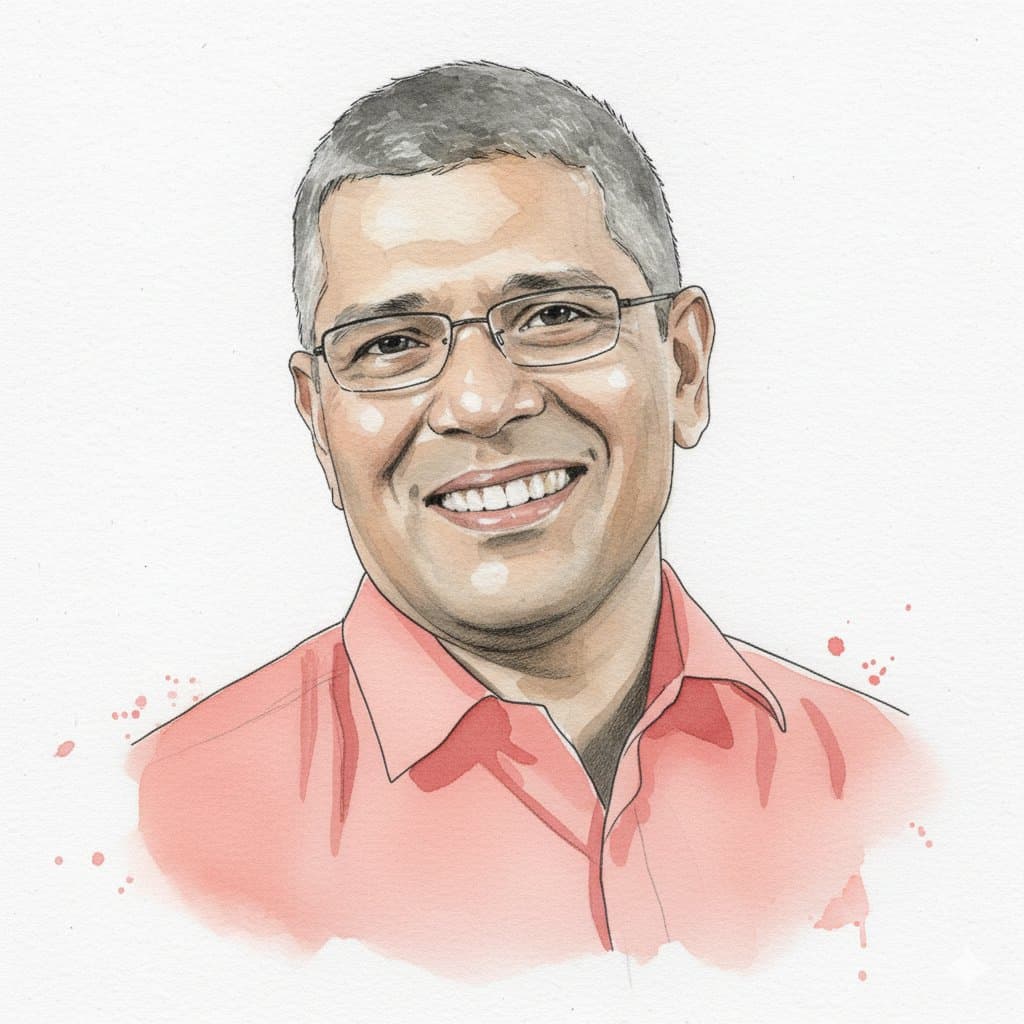
Prem Menon
Founder, Simpleworks Consulting. 39 years across Telecom, Automotive and Consumer Durables — now helping Indian MSME and family-business founders grow with clarity.