How to Choose the Right MSME Business Coach in India
The Indian market is full of people calling themselves business coaches. Before you commit six months and a meaningful fee, here are five questions that separate the right coach from the rest.
The market for business coaching in India has never been larger — or more confusing. Search for "MSME business coach" and you will find motivational speakers, YouTube educators, franchise coaching networks, retired executives offering advice, and everything in between. All of them are coaching. None of them are identical. And choosing the wrong one does not just waste money — it wastes the six to twelve months that most serious coaching engagements require, during which your business needed to be moving.
This post gives you a framework for making that choice clearly. Five questions. Each one designed to eliminate the wrong options and surface the right one.
Why This Decision Is Harder Than It Looks
The challenge with choosing an MSME business coach is that the output of good coaching is not immediately visible. A new machine on your factory floor produces results you can measure in week one. A coaching engagement produces results over months — in the quality of decisions made, the clarity of direction, the performance of the team. Because the value is deferred and diffuse, it is hard to evaluate a coach in advance.
This makes the market susceptible to substitutes. A confident speaker who fills a room with energy feels like coaching. A well-produced online course with ten modules feels like coaching. A senior person who takes your call once a week and gives you advice feels like coaching. None of these are wrong as products. But for an MSME founder running a ₹10–40 crore business with real operational complexity, these substitutes do not do the job.
The five questions below are designed to help you find a coach who does.
Question 1: Have They Run or Operated Inside a Real Business?
This is the first and most important filter.
An MSME business coach who has only ever coached — who built their career teaching frameworks or facilitating programmes — can tell you what good decisions look like in theory. They cannot tell you what they feel like when you are sitting across from a supplier who is threatening to cut your credit terms, or a family member who is blocking a necessary restructuring, or a sales team that is hitting activity targets while missing revenue targets.
The Indian business coaching market has a significant proportion of coaches who came through training organisations, NLP certification programmes, or motivational speaking backgrounds. These individuals may be skilled at facilitation and excellent at helping people set goals. But the depth of experience required to navigate the specific texture of Indian MSME challenges — family dynamics, regulatory constraints, distributor relationships, labour management — comes from having been inside those situations, not from studying them.
Ask any potential coach directly: where did you develop your understanding of how Indian businesses actually work? The answer should include real operational experience — not only training clients.
At Simpleworks Consulting, the basis of every engagement is nearly four decades of practitioner experience across consumer durables, automotive, telecom, and SaaS. The frameworks are not imported from business school. They are developed from watching what works and what doesn't in Indian companies over a very long time.
Question 2: Do They Work One-to-One or Primarily in Groups?
This question eliminates most of the high-volume coaching products in the market immediately.
Group coaching programmes — weekend workshops, cohort-based courses, accountability groups — serve a real purpose. They are affordable, accessible, and effective for helping business owners develop general skills and mindsets. Rajiv Talreja's Quantum Leap, ActionCOACH's franchise model, Rahul Malodia's programmes — these have genuinely helped thousands of business owners who needed structure and community.
But a group programme cannot address your specific problem. It can teach you principles. It cannot diagnose why your margins are compressing despite growing revenue. It cannot help you navigate a specific conflict with your business partner. It cannot stay with you through the particular challenges of implementing a pricing change with your top three customers.
One-to-one work is not just more personalised. It is a fundamentally different kind of engagement. The coach knows your business in detail. The questions they ask are specific to your situation. The feedback is about your decision, your team, your numbers — not a generalised case study designed to apply to many businesses at once.
For an MSME with real operational complexity, group coaching is preparation. One-to-one coaching with an experienced MSME business coach is the work.
Question 3: Will They Come to Your Business, or Do They Only Work Remotely?
This question reveals something important about how a coach understands the work.
Remote coaching — video calls, phone sessions, digital check-ins — has a legitimate place. For ongoing advisory relationships once context has been established, remote is efficient. But the diagnostic phase of a serious coaching engagement cannot be done remotely. Walking a factory floor, sitting in a sales team meeting, watching how the leadership team interacts in real time — these are not available on a video call. And without them, a coach is working from a description of your business, not from direct observation of it.
The Indian MSME context makes this even more important. The real dynamics of a family business — who defers to whom, which conversations happen in the room versus outside it, how decisions are actually made — are visible in person and invisible on a screen.
An MSME business coach who is serious about producing results will insist on being present in your business, especially at the start of an engagement. If a coach you are evaluating works entirely remotely or defaults to video calls without ever visiting your operations, that is a signal worth noting.
Question 4: What Do They Do When the Plan Isn't Working?
Every coaching engagement eventually hits a moment where the agreed direction meets unexpected resistance. A key customer doesn't respond as expected. The team is not adopting a new process. A family member is actively undermining a decision. Cash flow changes the available options.
In these moments, the quality of a coach becomes visible. A good MSME business coach does not walk away from the plan at the first sign of difficulty. But they also do not hold rigidly to a plan when reality has changed. They help you think clearly under pressure, adapt without losing direction, and maintain momentum when it would be easier to stall.
Ask any coach you are evaluating: what happens when the approach we agreed on isn't producing results? How do you handle that? A confident, specific answer tells you the coach has been through this before. A vague or defensive answer tells you they haven't.
Question 5: Are They Honest About What They Cannot Help With?
The fifth question is perhaps the most counterintuitive.
The right MSME business coach for your business will tell you clearly what they are not equipped to help with. A coach who claims to solve every kind of business problem — strategy, operations, family dynamics, financial restructuring, HR, digital marketing — is either extraordinarily experienced or is overstating their scope. In either case, the claim warrants scrutiny.
The honest coaches are the specific ones. They know what kinds of businesses they understand deeply, what kinds of problems they have genuinely solved, and where their experience runs thin. That specificity is not a weakness — it is the foundation of trust.
When you evaluate a potential business coach, look for this specificity. What kinds of businesses do you work with most? What problems have you solved repeatedly that you can speak to with confidence? Where would you refer me elsewhere? The answers will tell you more about the coach's integrity than any testimonial.
The Counter-Argument: Does Any of This Really Matter?
Some business owners read a list like this and think: "I just need someone good. I'll know it when I see it." There is something to this. Chemistry matters. Trust matters. The owner who clicks with a coach is more likely to do the uncomfortable work of changing how they think and operate.
But chemistry is not sufficient without competence. A coach who is warm and engaging but has not navigated Indian MSME realities will give you confident advice that doesn't hold in your context. A coach who is brilliant but works primarily in group formats will not address the specific problem your business has in front of it right now.
The five questions above are not a bureaucratic checklist. They are a way of quickly identifying whether a coach has what your business specifically needs — before you commit six months and a meaningful fee to finding out.
One More Thing Worth Saying
The best coaching relationships in Indian business are not dramatic. They do not produce the kind of transformation stories that make good social media content — the founder who tripled revenue in ninety days, the business that went from zero to a hundred crore in a year.
What they produce is quieter and more durable: an owner who makes better decisions more consistently, a team with clearer accountability, a business that grows at a pace it can sustain, and a founder who is building a company rather than running one.
That is the correct benchmark for what an MSME business coach should deliver. Not a highlight reel. A better-run business.
If you are looking for that kind of engagement — one-to-one, in-person, grounded in decades of real operational experience across Indian industries — see how Prem Menon works with MSME business owners →
About Prem Menon
Prem Menon is the founder of Simpleworks Consulting, working with MSME founders and growth-stage businesses across India to turn strategy into execution. With experience spanning manufacturing, SaaS, retail, and professional services, Prem brings a practitioner's eye to the problems most consultants only theorise about.
Ready to find out if this is the right fit for your business?
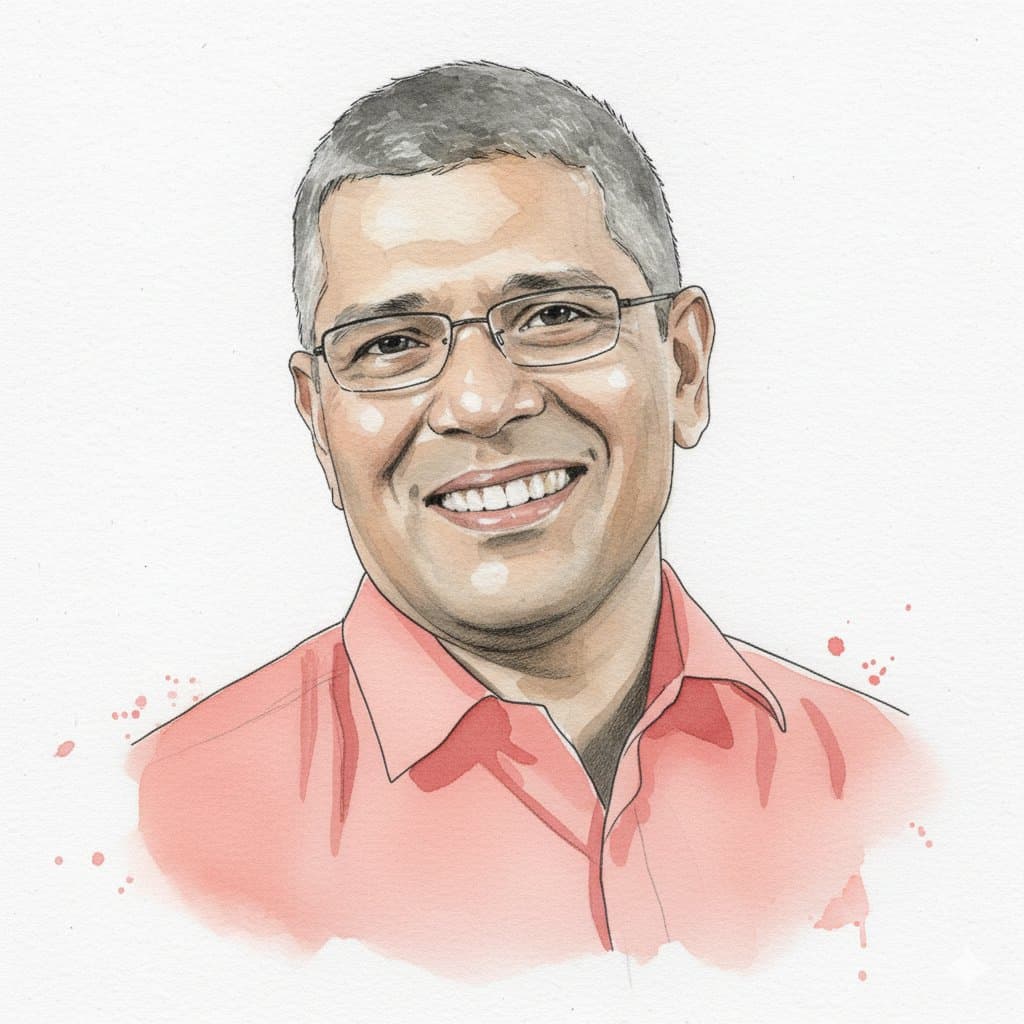
Prem Menon
Founder, Simpleworks Consulting. 39 years across Telecom, Automotive and Consumer Durables — now helping Indian MSME and family-business founders grow with clarity.