How to Build a Start-up Has Changed. But "What to Build" Is the Only Question That Still Matters.
The rules of company building have changed — quietly, completely, and faster than most founders realise. Four eras in forty years, and we've just entered the one where trust is the only moat that matters.
Two data points landed in front of me this week and I haven't been able to stop thinking about them together.
The first: YC's 2025 cohort data shows a significant and growing share of companies entering with 1–2 person founding teams — often with no plans to hire aggressively. The second: a widely-shared essay declaring we've entered the Distribution Era, where the moat in B2B software is no longer what your product does, but how many people already trust you before they try it.
On the surface, these look like two separate trends. They are not. They are the same shift, viewed from two angles. And together, they rewrite the playbook for how to build a start-up — especially if you're young, early, and starting from scratch.
But here's the thing most people will miss: both signals are about how to build. The deeper, harder question — the one most founders skip entirely — is what to build. That's the question this article is really about.
Four Eras of Company Building — And Why Each One Stopped Working
To understand why the Distribution Era matters, you have to understand what came before it. Company building has gone through three distinct eras in the last forty years. Each one had a dominant logic. Each one produced winners. And each one eventually stopped being sufficient.
Era 1 — The Product Era (1980s–2000s)
The first era was simple: build something that works. Technology itself was the scarce resource. If your software solved a real problem and ran reliably, you had a business. Competitors were slow. Customers were forgiving. The moat was the product.
Microsoft won because Windows worked. Oracle won because its database was reliable. SAP won because no one else had built ERP at that scale. The founding insight of this era: technology is hard, and most people can't do it. If you could, you had an almost automatic advantage.
This era ended when technology stopped being hard enough. The pool of people who could build software expanded. Open source libraries collapsed development costs. The product moat eroded.
Era 2 — The Capital Era (2000s–2015)
When product alone stopped being sufficient, capital became the weapon. The logic shifted: raise more money than your competitor, use it to acquire customers faster, dominate the market before anyone else can establish a foothold, then build the moat from position.
Uber didn't win because its technology was superior to Ola's. Flipkart didn't win on product elegance. They won — or tried to win — by deploying capital faster than the market could respond. The founding insight of this era: speed of scaling beats quality of product. Get big, get there first, figure out the unit economics later.
This era ended badly for many of its most celebrated companies. WeWork, Zomato's early iterations, dozens of Indian hyperlocal start-ups — they discovered that capital can buy growth but cannot buy a business model. And when the capital stopped, so did the companies.
Era 3 — The Growth Era (2015–2022)
The third era was more sophisticated. It combined product and distribution into a single motion: build the product in a way that carries its own distribution. Virality, network effects, freemium funnels, product-led growth. The product acquires its own customers.
Slack spread through office networks because inviting a colleague was part of using it. Notion grew because sharing a Notion page required the reader to sign up. Canva grew because every design had "Made with Canva" at the bottom. The founding insight of this era: the product is the GTM strategy.
This era worked brilliantly — until AI made it possible to clone a product's features in weeks. When the product itself can be replicated rapidly, PLG loops break down. Your viral mechanic gets copied. Your freemium tier gets undercut. The growth era assumed product differentiation would hold long enough for network effects to kick in. AI compressed that window to near zero.
Era 4 — The Distribution Era (2023–now)
Which brings us to where we are. When product can be built fast, when capital is no longer freely available, and when growth hacks get replicated overnight — the only thing that cannot be copied quickly is the trust and context you've built with a specific group of people.
Context is earned, not bought. It accumulates through consistency, specificity, and genuine usefulness over time. It is the one moat that gets stronger the longer you hold it — and the one thing a better-funded competitor cannot replicate with a bigger team or a faster AI.
The two data signals we started with — 1–2 person founding teams and audience-before-product — are both symptoms of this shift. They are what rational company building looks like when you understand that the era has changed.
The 1–2 Person Company Is Not a Bug. It's the New Default.
For thirty years, the company-building script read like this: idea → co-founders → seed round → team → product → growth. The team came before almost everything else. Headcount was treated as a proxy for seriousness.
YC's data is quietly dismantling this script.
When Paul Graham wrote Do Things That Don't Scale in 2013, it was advice about tactics. What YC is now seeing is something structural: AI has made certain roles redundant before the company even needs them. A solo founder with Claude, Cursor, and a few focused agents can do what previously required a 5-person team — and do it faster, with less coordination overhead.
This is not about being lean for the sake of it. It's about a genuine collapse in the cost of producing capability. The marginal cost of a second or third hire used to buy you capacity. Now it buys you coordination problems.
The 1–2 person company is the rational response to this reality.
What this means practically: the bottleneck in early company building has shifted from labour to judgment. You don't need more people to execute. You need one person who knows exactly what to do — and who has the tools to do it faster than a team of five could have a year ago.
This is clarifying in one way, and brutal in another. There is nowhere to hide. The founder's judgment is the company.
Distribution Is the Moat — But Only If You Built It Before You Needed It
The Distribution Era essay makes a point that sounds obvious until you trace its real implications: in a world where AI can produce software faster than ever, the product itself is no longer the hard part.What's hard is getting people to care about your product before your competitor's version ships.
The traditional GTM playbook — build product, raise money, hire sales, run outbound, attend conferences — assumes you are starting your distribution effort after your product exists. That sequence made sense when products took 18 months to build. It doesn't when a capable MVP can exist in 6 weeks.
The new sequence is inverted: audience first, product second.
Dhruv Nath, Sahil Bloom, Lenny Rachitsky — these are not just "content people." They are founders who built distribution before they built anything to sell. When Lenny launched Lenny's Newsletter, he had no product. By the time he launched his job board and consulting services, he had 200,000 people who already trusted him. The product almost didn't matter.
This is not a social media strategy. It's a go-to-market architecture decision. It answers the question: where will your first 100 customers come from, and why will they trust you enough to try something unproven?
For a young founder, the honest answer to that question is almost always: they won't, not yet. Which means the distribution work is not optional prep — it's the actual first chapter of building the company.
In the Indian context, where founder credibility travels heavily through networks — alumni groups, community WhatsApp threads, industry associations — this plays out with even more intensity. The GTM playbook for Indian MSMEs and startups is almost always network-first. You earn trust before you earn revenue.
What makes distribution a moat — and not just a marketing tactic — is time. An audience you've built over two years is not something a better-funded competitor can replicate in two months. Distribution compounds. Product features don't.
The Question Nobody Is Asking: What to Build
Here is where most of the "new startup playbook" writing stops. Build an audience. Use AI to move fast. Keep the team small. All true. All insufficient.
What to build is a harder question than how to build it, and it is the one question that AI cannot answer for you.
The distribution era and the 1–2 person company both assume you've already cleared this hurdle. They're operating manuals for a car you've already decided to buy. But most founders are still standing in the parking lot, looking at the wrong vehicles.
The failure mode I see most — and at Simpleworks Consulting, I see this across MSME founders and startup operators alike — is building something technically feasible and commercially orphaned. The founder used AI to build fast. They built in public, grew a small audience. They shipped. And then: silence. Not because the product was bad, but because they built a solution before they understood the weight of the problem.
What determines what to build? Three filters, in order:
1. Intensity of pain, not breadth of problem.
The instinct is to build for large markets. The better instinct is to build for screaming problems. A market of 10,000 people who desperately need something is more valuable than a market of 1,000,000 people who would mildly appreciate it. The Distribution Era amplifies this: a small, intense audience is easier to build and easier to convert. The tighter the pain, the faster the trust.
2. Your earned insight, not your observed opportunity.
There is a difference between a problem you've noticed and a problem you've lived. The most dangerous startup decisions are made by founders who saw a market gap from the outside and assumed proximity to the problem. The 1–2 person company has no room for this error. When your team is two people, you cannot afford to learn the domain from scratch while also building. You need earned insight — the kind that comes from having been inside the problem, either as a practitioner or as a customer who was badly failed by existing solutions.
3. Defensibility through specificity, not features.
In the Distribution Era, your first product cannot be a broad platform. Broad platforms require trust you haven't earned yet. Your first product should be so specific it feels almost too narrow. A payroll tool for Indian D2C brands under ₹10 crore. A proposal generator for independent management consultants. A churn analytics tool for SaaS companies with less than ₹5 crore ARR. The specificity is not a limitation — it's the distribution strategy. Specific products reach specific people through specific communities. And communities are how the Distribution Era works.
The Counter-Argument Worth Taking Seriously
Someone will read this and say: "You're describing a content creator's playbook, not a founder's. Building an audience takes years. Most people don't have that time or that temperament."
That's a fair objection. Not every founder is a natural writer or a comfortable public thinker. And the runway problem is real — two years of audience-building before revenue is not available to most people starting from zero.
The honest response is this: the Distribution Era does not require you to be a media personality. It requires you to be findable and trusted within a specific context. That could mean:
- Writing one clear, useful thing every week for a niche LinkedIn community
- Building in public inside a Slack group or WhatsApp network where your customers already congregate
- Partnering with someone who has the audience while you have the product
The audience-first model is not "go viral." It's "be the most useful, most known person in a small pond." That is achievable in 6–9 months for someone disciplined and specific enough.
The deeper point stands: if you cannot answer who already knows you, why do they trust you, and how will they find out this product exists — your product strategy has a hole in it that no amount of AI tooling will fix.
A New Playbook for a Young Founder
If I were advising a 25-year-old sitting across from me today, the playbook would look like this:
Month 1–3: Pick your problem, not your product.
Go deep on one domain. Not "fintech" or "SaaS tools." Pick one narrow pain — yours, or one you have genuine proximity to. Write about it. Talk to 20 people who live with it. Find out what they've tried and why it failed. Do not build anything yet.
Month 3–6: Build your distribution before your product.
Write one useful thing per week, in the channels where your eventual customers spend time. Not polished content marketing — sharp, specific observations that only someone with real domain knowledge could make. This is how you earn the right to sell to people before they've seen your product.
Month 6–9: Build the smallest thing that solves the sharpest part of the problem.
One job. Done completely. Use every AI tool available to build it with 1–2 people. Do not raise money to build what you could build without it.
Month 9–12: Sell it to the people who already know you.
Your first 20 customers should come from people who've been reading, watching, or talking to you. If that's not true, your distribution work wasn't specific enough — go back and tighten it.
This is not a 4-step formula. It's a sequencing principle. The real work of execution is messier and more iterative than any framework captures. But the sequence — problem before product, distribution before launch, specificity before scale — is the part most young founders get backwards.
The Only Advantage That Compounds
Features get copied. Funding gets matched. Pricing gets undercut.
What doesn't get copied easily is the trust you've built with a specific group of people, and the depth of your understanding of a problem that most people only see from the surface.
The Distribution Era is not telling you that marketing is the new product. It's telling you that trust is the new barrier to entry. And the 1–2 person company is not a signal that teams don't matter — it's a signal that judgment matters more than headcount.
But none of it works if you're building the wrong thing.
The question worth asking, before you touch a single AI tool or write a single line of code, is the oldest one in business: does this problem hurt enough, for enough people, that they'd pay someone to take the pain away?
If the answer is yes, build fast, build small, and build your audience before your product.
If the answer is unclear, stay in the problem longer. The speed advantage AI gives you is worth nothing if you're moving fast in the wrong direction.
About Prem Menon
Prem Menon is the founder of Simpleworks Consulting, working with MSME founders and growth-stage businesses across India to turn strategy into execution. With experience spanning manufacturing, SaaS, retail, and professional services, Prem brings a practitioner's eye to the problems most consultants only theorise about.
Ready to figure out what to build — and how to make it land?
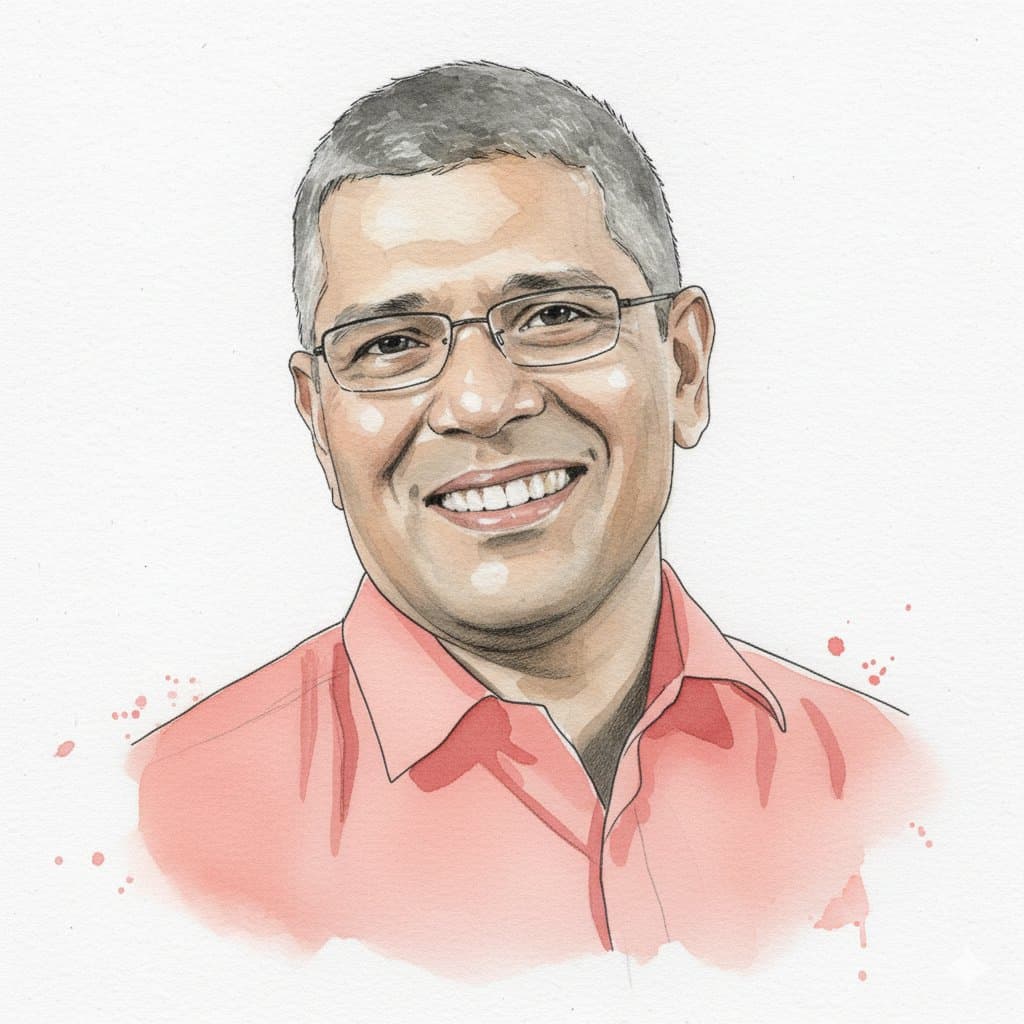
Prem Menon
Founder, Simpleworks Consulting. 39 years across Telecom, Automotive and Consumer Durables — now helping Indian MSME and family-business founders grow with clarity.