From Founder to CEO - How Indian MSME Leaders Build Businesses That Run Without Them
The habit that built your MSME to ₹5 crore is the same habit that will stop it from reaching ₹10 crore. Here's how Indian founders make the shift from doing the work to building the system that does it.
Most Indian MSME founders built their business the same way: by being the best at something and doing it themselves. They handled the sales call personally. They checked every invoice. They solved the production problem nobody else could. That capability is what got them to ₹2 crore, ₹5 crore, maybe ₹10 crore. It is also, if left unchecked, exactly what will stop them from going further.
The transition from founder to CEO — from the person who does the work to the person who builds the system that does the work — is the defining challenge of every growing MSME in India. As a business mentor for founders India-wide, I have watched this transition succeed and I have watched it fail. The difference is rarely intelligence or effort. The difference is whether the founder understands what they need to stop doing, what they need to build instead, and in what order.
This post lays out the transition plainly: the trap, the three systems that break it, and the behaviours that have to go.
Why the Founder Becomes the Bottleneck — The Hidden Cost of a Founder-Led Business
There is a moment in most founder-led businesses when the company stops growing not because the market ran out or the product stopped working, but because everything routes through one person.
Consider what that looks like operationally. Customers call the founder directly because that is how deals close. Staff escalate every non-routine decision upward because the founder has always been the decision-maker. Suppliers negotiate at the top because that is where the authority lives. The result is a business that functions beautifully at ₹5 crore but cannot scale past ₹8 crore without the founder working an 80-hour week.
This is not a motivation problem. It is a structural problem. The business was built around a person, not around a system. And a business built around a person has a hard ceiling — the ceiling of that person's available hours.
The Ambani example is useful here, not because most MSMEs operate at that scale, but because the pattern is universal. Dhirubhai Ambani is remembered as one of India's great business builders, but what made Reliance endure beyond him was not his personal capability — it was the institutional muscle he built over decades. A business mentor for MSME founders will tell you the same principle applies at ₹10 crore as it does at ₹10,000 crore. Businesses that outlast their founders are built on systems, not on talent.
The 3 Systems Every Founder Must Build to Move from Operator to CEO
The transition from operator to CEO is not a mindset shift. It is an operational one. It requires three specific systems to be in place before the founder can genuinely step back.
System 1: A Decision Architecture
Most MSME founders have never explicitly mapped which decisions should require their input and which should not. As a result, everything requires their input.
A decision architecture is simply a written agreement — with yourself and your team — about what level of authority each type of decision requires. Operational decisions below a certain cost or risk threshold get delegated, fully and permanently. Strategic decisions above the threshold stay with the founder. The line has to be drawn explicitly, because if it is not drawn, it defaults to "everything comes to the founder."
The test of whether this system is working is not whether the founder feels comfortable with it. It is whether the team is making good decisions without escalating. If they are escalating things you think they should be able to decide, the system is not built yet — or the team has not been trained to use it.
System 2: An Accountability Rhythm
Delegation without accountability produces chaos. This is the number-one reason founders in India take back what they delegated: something went wrong, and there was no system in place to catch it early.
An accountability system for a small business does not need to be elaborate. It needs three things: clear ownership of outcomes (not activities), a regular cadence to review progress, and an agreed response when something slips. That cadence might be a Monday morning check-in of twenty minutes with each team lead. It might be a weekly number that gets posted to a shared sheet. The mechanism matters less than the discipline of actually doing it.
Building accountability systems for small business India is the area where most MSME founders underinvest. They delegate the task but not the outcome, and without a review rhythm, delegation becomes abdication.
System 3: A Talent Layer That Thinks
The hardest part of the transition for most founders is not building the systems. It is accepting that the business needs people who can think — not just execute — and then actually hiring them.
Many MSME founders have built a team of loyal, competent executors. People who do exactly what they are told, reliably and without drama. What they have not built is a second layer of people who can make judgement calls, manage other people, and own a function end to end.
This is a deliberate hire, not an accidental one. The profile of someone who can run your sales function while you focus on strategy is different from the profile of your current best salesperson. Conflating the two is one of the most expensive hiring mistakes a founder-led business consultant encounters regularly.
The Behaviours a Founder Must Let Go Of — Even When It Feels Like Dropping the Ball
Working with a business mentor for MSME founders, the behaviour patterns that are hardest to shift are not the dramatic ones. They are the quiet, daily habits that feel like conscientiousness but are actually control.
The first is the instinct to fix things personally. When a customer complaint comes in, the founder jumps on it. When a team member makes an error, the founder corrects it directly. Every intervention sends the same signal to the team: when something goes wrong, wait for the founder to handle it. Over time, that signal trains the team not to solve problems — because why would they, if the founder will do it anyway?
The second is the habit of being in every meeting. Founders who are present in every customer conversation, every supplier negotiation, every internal planning session, are not leading the business. They are running it. There is a difference. Leading means setting direction, building capability, and removing obstacles. Running means being the obstacle remover. Only one of those scales.
The third, and most counterintuitive, is the need to be the smartest person in the room. The founders who transition most successfully are the ones who hire people who know more than them in specific domains and are comfortable with it. The ones who struggle are the ones who, consciously or not, surround themselves with people who will not challenge them.
The Counter-Argument: "My Business Is Different. It Needs Me."
The most common pushback I hear from MSME founders when I raise this transition: "My business relies on relationships. Customers buy from me, not from my company. I cannot extract myself the way a product business can."
This is true — partially. Relationship-driven businesses are genuinely harder to systematise. A CA firm, a boutique manufacturer, a B2B services business built on the founder's personal network — these do have founder dependency baked into the model in ways that a packaged product business does not.
But "harder to systematise" is not the same as "impossible to systematise." What it requires is a longer transition timeline and a different approach: not removing the founder from relationships, but building parallel relationships through a team. The founder remains involved in the highest-value relationships. The team owns everything else. Over 18–24 months, the dependency shifts.
The real risk in using "my business is different" as a reason to delay the transition is not that the argument is wrong. The risk is that it is right just enough to be convincing, while quietly ensuring the business never grows past the founder's personal bandwidth.
The Transition Is Not an Event — It Is a Discipline
The shift from founder to CEO does not happen at a particular revenue milestone or after a particular hire. It is a discipline practised in small decisions, every day.
It happens when you let the team handle the complaint instead of picking up the phone yourself. When you come out of a meeting and ask "did that need me?" and start saying no more often. When you hire someone into your team and let them be better at their function than you are.
None of this is comfortable. Building a business that runs without you, by definition, means building something that does not need you in the way it once did. For founders who built the business from nothing, that can feel like loss. What it actually is, is growth — yours and the company's.
If you are at the stage where the business feels like it is plateauing with you at the centre, the problem is not effort. It is architecture. The right time to build the systems is before you feel you need them — because by the time you feel it acutely, you are already in the trap.
About Prem Menon
Prem Menon is the founder of Simpleworks Consulting, working with MSME founders and growth-stage businesses across India to turn strategy into execution. With experience spanning manufacturing, SaaS, retail, and professional services, Prem brings a practitioner's eye to the problems most consultants only theorise about.
Ready to build a business that runs without you?
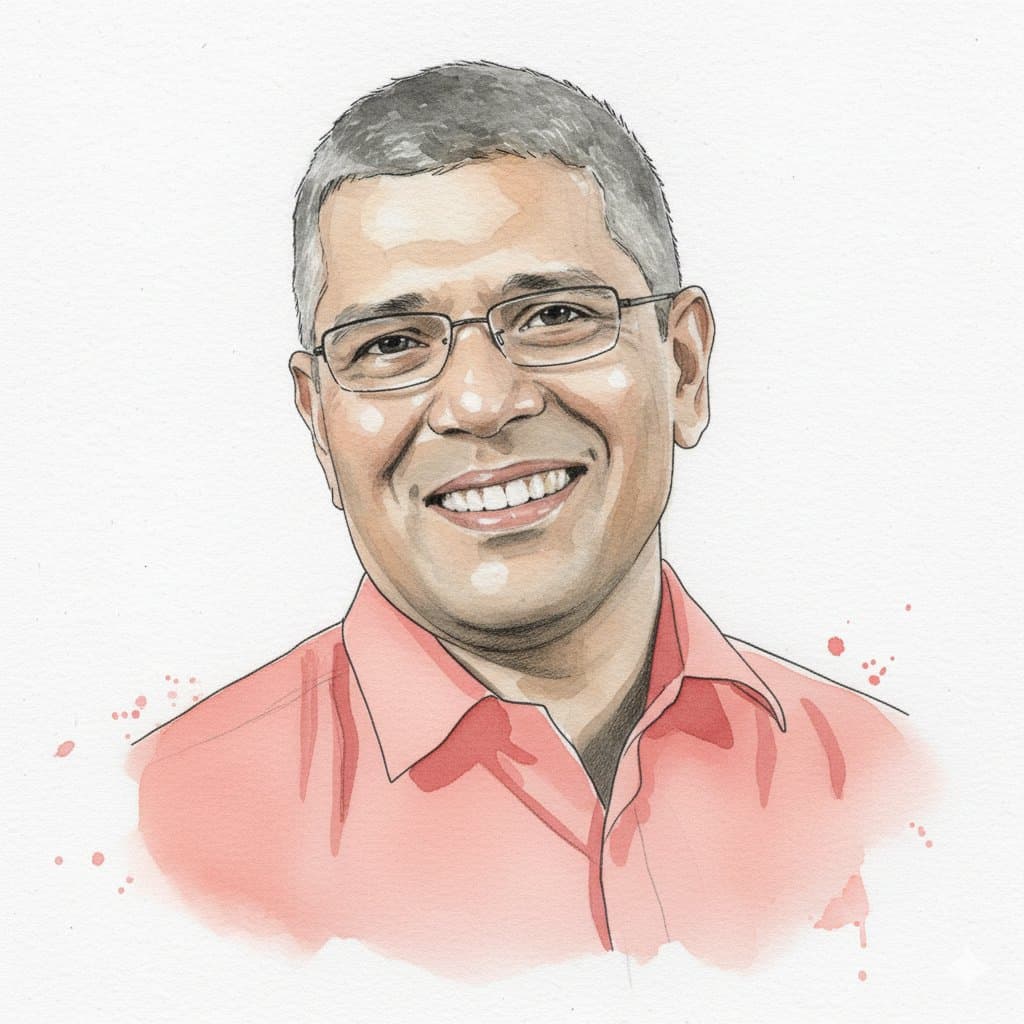
Prem Menon
Founder, Simpleworks Consulting. 39 years across Telecom, Automotive and Consumer Durables — now helping Indian MSME and family-business founders grow with clarity.